
Car seat cot death – the hows and whys?
Car Seat Cot death is thankfully very rare, but shouldn’t be discounted as a potential risk. Car seats are all to readily available as a piece of equipment to let babies sleep in around the house as well as the car. But what are the risks and how can you avoid them?
Two key studies into cot death provide some statistics and practical advice.
Study One
A study at the Auckland Cot Monitoring Service in New Zealand investigated nine babies who had been referred to the service between July 1999 and December 2000 after a life threatening event.
The nine healthy infants aged between three days to six months had been discovered not breathing.
Eight of these incidents occurred while the baby was sleeping in a car seat in the home. One while the baby was in a car seat during a journey. All car seats were appropriate to the child’s age.
During the study whilst recreating the incidents, all the babies heads were found to be flopped forward restricting their air flow.
Researchers stressed that other factors may have been important. Half the mothers were smokers. Smoking is well known to increase the risk of cot death.
Study Two
In 2007 a study lead by Aurore Cote, looked into the deaths of 508 infants in Quebec between 1991 and 2000.
The study included looking at whether infants placed in the sitting position were more likely to die than those placed lying down.
Of the 508 deaths, 409 were classified as unexplained after full and appropriate investigation.
A total of 17 out of the 508 deaths occurred in infants in a sitting position.
Of these 17, a total of 10 fell into the unexplained death category.
What this suggests is that there is a risk that young babies may experience respiratory problems if placed in car seats. The risk was found to be no greater should the baby have been born prematurely.
What you should be aware of
Young babies may experience respiratory problems if placed in a sitting position or car seat. A baby’s reflex to keep the head held up is not fully developed when still a newborn, making their heads flop down and restrict their airways. This is why it is always best to keep a young baby on their back wherever possible. Car seats should only be used to transport babies in cars, and other sitting baby equipment should only be used once the baby is strong enough to support their own head.
A spokesperson from the Foundation for the Study of Infant deaths (FSID) said: “We don’t advise that babies sleep in car seats except in the inevitable circumstances of falling asleep on a journey. Car seats are designed to keep babies safe while travelling, not as a primary sleeping place. We advise that there is an adult in the car, other than the driver if possible, who will keep a close eye on the baby.
“There are concerns that babies airways MAY become compromised by the position they adopt in car seats and this is especially a problem the smaller the baby is.
“We suggest that frequent breaks are taken on a long journey to get the baby out of the seat, even if this involves waking him up. Same thing if bringing the baby back into the house if she has fallen asleep in the car seat. The baby’s warm outdoor clothing should be taken off even if this involves waking the baby. If he is due a sleep he should be taken out of the car seat and put into his cot or crib. The safest place for a baby to sleep is on a firm, flat mattress, and obviously a car seat doesn’t meet this requirement.”
What about car seats in prams
All the advice suggests that babies should not spend longer than possible in a car seat, especially whilst sleeping, so what about prams that have car seats in them?
In an informal observation, Chopsy Baby contributors noticed that parents were relying on car seats for babies to sleep in. Worryingly, it was found some parents would put their baby into a car seat for the drive. The seat would then be put into a travel system pram whilst out and about. The baby in the car seat would then travel back home in the car, and if the baby was still asleep, parents would take them out of the car in the car seat and let the infant continue to slumber in it whilst in the house. Some babies were spending hour after hour in car seats.
FSIDS said: “Using a pram which has a car seat type top is OK for the trips when the baby is being pushed by an adult, and is obviously convenient to lift in and out of the car, but it shouldn’t be used as a primary sleeping place, and as above, the baby should not be left to sleep indoors in this type of pram, in outdoor clothes, having fallen asleep while out.”
What do car seat manufacturers say?
The new baby car seat from Strata has recently been awarded the highest possible safety marks for Group 0+. Its unique design allows angle of the back rest to be adjusted by parents.
Director of Johnston Prams & Buggies David McCullough said “There are currently eight car seats within the Jané range, each classified according to the weight of the infant it can safely accommodate. Each car seat is just that – a seat specifically designed to support a child travelling in a car, providing comfort and stability in transit and maximum protection in the event of an accident. What car seats are not designed to provide is long term rest, both inside and outside of the vehicle, a car seat is a temporary solution with a specialist purpose.
“Jané has developed Strata, a group 0 + car seat (suitable for babies weighing 0 – 13kg), the first infant carrier that helps perfect pulmonary development for newborn babies. Strata from Jané is designed for the complete comfort and well being of your baby. Strata has obtained maximum marks in Group 0 + belted car seats in the European test performed by child safety experts and consumer organisations.
“A new patented system regulates the angle of the backrest to create the most suitable position for your baby. For babies aged 0 – 4 months, lowering the backrest automatically adjusts the harness and raises the base of the seat, increasing the angle of the backrest to an optimum 125°. From 4 months upwards, Strata adapts to your baby’s growth. Raising the backrest will alter the harness and return the base to its original position, creating an angle of 110°. This technology has helped earn the Jané Strata recognition as the safest and healthiest car seat on the European market.”
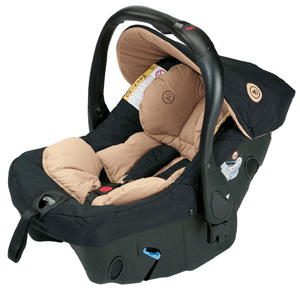
Stephen Hughes from the British Chiropractic Association said: “The movement of the car will often have a soothing effect on the baby and as a consequence they will then fall asleep giving the impression that they are comfortable. It is important not to leave an infant in a car-seat for more than two hours maximum even if they’re asleep. On long journeys stop regularly somewhere safe and take the baby out of the seat and allow them to stretch out on your shoulder. Never allow a baby to sleep in a car seat if you are not actually traveling in a car.”
Help avoid car seat cot death
The safest place for a baby to sleep is in a cot or crib on their back and in the same room as a parent or carer.
You should never use a car seat in the house for your baby to sleep in.
Stop your baby from scrunching up and over, keep and eye on their neckline.
Make sure the car seat you buy is age appropriate and correctly fitted.
Make sure grandparents and carers know how to fit the car seat and watch them practice.
Where possible, babies travelling in a car seat should be observable by a responsible adult.
If you are a loan driver driving a significant distance use services to check on your baby.
Babies find it difficult to regulate their temperature and quickly overheat. When in the car remove any head gear the baby is wearing as they lose excess heat through their head.
Be wary of thick snow suits. It may be cold outside, but cars can heat up quickly natural materials will help the baby’s body with heat rather than nylons, polyester and man made fabrics.
Cot seat cot death is very rare but take precautions to lower the risk
FSID runs a Helpline (020 7233 2090) for parents and professionals seeking advice on safe baby care. The Helpline also supports bereaved families.