
Oliver McGowan Mandatory Training Will Save the Lives of People With Autism and Learning Difficulties
Last week, a major change happened in the way that health care staff will treat patients with autism and learning difficulties in the future. The announcement was made by MP Caroline Dinenage, but the driving force behind the change came from one bereaved mother, who managed to bring about significant change where successive governments, major charities and the medical establishment had failed.
So many people across the world will have heard of Oliver McGowan by now. It should have been because of his sporting achievements, or perhaps another contribution he should have had the opportunity to make. Instead, we are familiar with the beautiful beaming smile from a photograph of a teenager whose life was tragically cut short in Bristol, in an event which should strike fear into the heart of everyone.
Consent and no means no is something that is dinned into children these days, but when Oliver said no and his family said no they were ignored in the cruelest way imaginable. During medical treatment at Southmead Hospital, Oliver was given no reasonable adjustments to help him adapt to the environment because of his autism and administered antipsychotic medication that he did not need and was also allergic to. Because of this, Oliver died.
Oliver’s story is not an isolated one. He is one of many patients with autism or learning difficulties who has been failed by the healthcare system due to a lack of provision, training and empathy.
There has been decades of research, recommendations and guidelines, none of which have been effectively implemented. There is, however, an effective way of monitoring the number of deaths of people with learning disabilities and we have that right here in Bristol, the same city in which Oliver died.
The LeDeR programme is based at the University of Bristol, funded by NHS England and is a system of collecting and reviewing the deaths of people aged four years upwards with learning disabilities. Its findings show that people with learning disabilities die an average of 15-20 years younger than those without.
It also finds that the proportion of people with learning disabilities who died in hospital was 64 per cent compared to 47 per cent without. And, that younger people with learning disabilities were more likely to die in hospital than older people, at 76 per cent for young people under the age of 24 compared with 63 per cent of those aged 65 and over.
National recommendations made by LeDeR based on local reviews of deaths in 2016/17 included ‘clearly identifying people requiring the provision of reasonable adjustments, record the adjustments that are required, and regularly audit their provision.’
And, ‘Mandatory learning disability awareness training should be provided to all staff, and be delivered in conjunction with people with learning disabilities and their families.’
Health inequalities existing for those with disabilities had been noted decades earlier. Mencap’s Death By Indifference report was published in March 2007, noting ‘… people with a learning disability who die in hospital – is the widespread ignorance and indifference throughout our healthcare services towards people with a learning disability, and their families and carers. We say that this is a national disgrace. We say this is institutional discrimination.’
They also talk about diagnostic overshadowing being a ‘key barrier to people with a learning disability getting equal treatment.’ Diagnostic overshadowing happens when doctors make ‘dangerous faulty assumptions’ about people with a learning disability that impacts upon their treatment. Often, this is believing that a symptom they are presented with is a feature of a learning disability and that nothing can be done about it.
Mencap also found that people with learning disabilities who struggle with communication skills were having to put up with extreme pain before getting the right treatment, if they got the right treatment at all.
A further independent inquiry in 2008 into access to healthcare for people with learning disabilities
by Sir Jonathan Michael, said that health services frequently did not adjust the way they did things to make it easier for people with communication difficulties and learning disabilities.
It also found that healthcare staff were not knowledgeable enough about disability and different parts of the healthcare service did not communicate well enough together. It also noted that because there is very little training, some NHS staff had ‘negative attitudes’ towards people with learning difficulties, ‘failing’ to treat people with ‘dignity or respect’.
NHS England is itself running the stopping over medication of people with a learning disability, autism or both (STOMP) programme. According to Public Health England, a staggering 30,000 to 35,000 adults with a learning disability are taking psychotropic medicines when they do not have the health conditions they were created for. And it’s not just adults being prescribed them. Children and teenagers are also being over medicated with inappropriate medication.
Whilst psychotropic medicines are appropriate for use in some patients, they can be given to patients whose behaviour is seen as ‘challenging’. People with autism or a learning disability or both, are more likely to be given psychotropic medication than other people.
In December 2016, the Challenging Behaviour Foundation published a consultation run with Stomp which concluded that young people and adults with autism and/or a learning disability continued to be ‘subjected’ to ‘inappropriate use of medication, with significant negative consequences for the individual.’
And, that came even after a pledge in July 2015 from NHS England promising rapid and sustained action to tackle the over-prescribing of psychotropic drugs to people with learning disabilities after three separate reports highlighted the need for change.’
If all of these various reports, inquiries and investigations were not enough, then the Autism Act of 2009 should have sorted it out.
In 2010, Fulfilling and Rewarding Lives, the first ever strategy for adults with autism in England was published. In it, access to all public services was covered and included training for healthcare professionals regarding autism. It said: ‘We also want to see the development of specialist training in health and social care so that staff – from consultants to community nurses – who wish to specialise in autism or develop further knowledge can do so, supported by their local health and social care community. The end goal here is that, within each area, there are some staff who have clear expertise in autism. They can then be consulted as required by colleagues.’
Yet in 2014, the replacement Think Autism strategy (2014) ‘builds’ on rather than replaces the themes in Fulfilling and Rewarding Lives (2010) and with it the note that the Royal College of GPs has made autism a priority for training and awareness over the next three years’ and that ‘autism awareness training will be made available to all mainstream healthcare professionals’.
So many reports, so many promises and so many failures to effect change. But something changed last week. Something incredible happened. The Government confirmed they would make sure all healthcare staff get autism training.
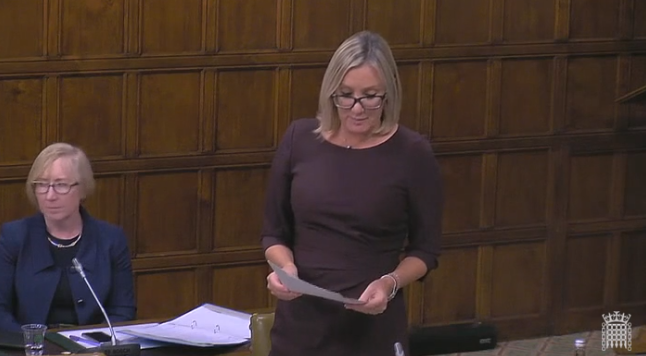
A debate took place in Parliament on Monday 22 October, in which Caroline Dinenage MP committed to mandatory training in autism for healthcare staff. There was one person at the very core of the debate – Paula McGowan. And one person right at its heart, her 18-year-old son Oliver.
Oliver McGowan died in Southmead Hospital on Armistice Day, 11 November 2016. There were many almost unbelievable failures in his care and shocking revelations at his subsequent inquest. The two-hour debate lays these facts down and it is difficult viewing.
Paula has always firmly believed that Oliver’s death could have been prevented if the staff treating him had had mandatory training. Oliver had autism, a mild learning disability, mild cerebral palsy and partial seizures. Staff had received no training about how to make reasonable adjustments for him.
In a petition that was signed by over 50,000 people and debated by MPs, statistics were quoted that found that 1 in 4 healthcare professionals has never had training on learning disability or autism, that two thirds want more training and that 1 in 3 think a lack of government leadership is ‘contributing to the problem of avoidable deaths’.
Labour MP Daniel Zeichner introduced the debate, making Paula’s words and Oliver’s memory a matter of record. He said: “Everyone working in the NHS will see autistic and learning-disabled people, even if unaware of it. All frontline staff, therefore, from GP receptionists to consultants in accident and emergency, should receive some evidence-led training about autism.”
Paula’s drive to bring the petition to parliament despite her own grief was fuelled by the motivation that in the future, children like her son Oliver would be safer.
Oliver had a Hospital Passport which was given to A&E staff. This is a vital document that detailed how his autism and LD affected him, how to make reasonable adjustments for this as well as his allergies to antipsychotic medication. It was not read but placed in a drawer. Oliver was not communicated with effectively and was restrained. Oliver made it very clear he did not want to be given antipsychotic medication as did his parents and it was clearly noted in the allergies box on his hospital documentation and care charts.
During Oliver’s stay in hospital, he was administered antipsychotic medication Olanzapine causing him to develop neuroleptic malignant syndrome (NMS). This caused a reaction which made his brain swell so badly, that it was bursting out the bottom of his skull causing irreversible brain damage.
Paula believes that mandatory autism training would have meant that staff treating Oliver would have known how to put in reasonable adjustments which would not have led to the need for chemical restraint and the catastrophic reaction that followed. Paula maintains that they did not explore other options to using antipsychotic medication such as humour, adjusting the sensory environment or using effective communication.
The inquest into Oliver’s death concluded on 20 April this year, with the coroner Dr Peter Harrowing finding that the care Oliver was given was “appropriate” despite Oliver, his family, his medical records and doctors making it clear that he was not to be given antipsychotics due to his previous reactions.
Dr Peter Harrowing said that Olanzapine had been properly prescribed and on the stand, Dr Monica Mohan said she had administered the drug he was allergic to because she believed it was in his “best interests”. The neuropsychiatrist, despite ten years of evidence that people with autism and learning difficulties are subjected to antipsychotics as a medical cosh, said she would do it again because it was the right thing to do.
This stance contradicts the GMC Ethical Guidance for Doctors which clearly states ‘you must respect a patient’s decision to refuse an investigation or treatment, even if you think their decision is wrong or irrational.’
At the time of the inquest’s findings, Paula said her family was ‘extremely disappointed with the Coroner’s conclusion and it was a process that was ‘frustrating and disheartening. She said that the NHS trust had been fiercely protective of doctors who she felt were ‘arrogant and dismissive’ of Oliver’s needs.
She said: “We remain adamant that Oliver would not have died if he had not been administered the Olanzapine, which we expressly forbade, that the coroner found triggered the NMS, a significant contributory factor to his death.
“It is clear from the evidence that no reasonable adjustments were made for Oliver in A&E on his arrival at Southmead Hospital. We believe this environment heightened his anxiety and was not appropriate for a teenager with autism and a learning disability.”
“Nothing will bring our vibrant son Oliver back, but we have clung on to the hope that the doctors at Southmead hospital would learn from their mistakes. We were therefore horrified that during her evidence, Dr Monica Mohan who prescribed the fatal doses of anti-psychotic medication said ‘I would do it again’, irrespective of our express wishes – and without further consultation with professionals who knew Oliver best – having acknowledged that we were ‘right all along’.”
During Monday’s debate, Jared O’Mara MP for Sheffield Hallam, spoke about the difficulties he faces as the first autistic MP in the heart of British democracy. He talked about feelings of invisibility and marginalisation from other MPs due to reasonable adjustments he’s been allowed. Whilst Speaking, he became deeply emotional about how the communication difficulties his autism causes has affected him. He connected with Oliver’s experience quite deeply. He knew Oliver’s treatment in hospital could easily have been his own.
“It’s really hard to hear the story of Oliver McGowan, it’s the story that’s inspired this debate and indeed the petition that triggered it,” Caroline Dinenage said, calling his family’s experience ‘heartbreaking’. The previous two-hours of debate was filled with appalling statistics which had been ignored for more than ten years. Oliver’s experience had been horrific, with the details jaw dropping.
Caroline said she was “absolutely committed to ensuring that all staff have the skills they need whether for learning disability or autism to deliver excellent, compassionate care and we’re already taking forward actions in this area.”
She said that the consultation would start in the New Year. And, her ‘aspiration’ would be for the Government’s final plans to be published by the summer of 2019 and regulations amended by the end of 2019.
“It’s absolutely vital that we do everything in our power to get this right. We owe it to Oliver and to the many, many young people with autism or learning disabilities whose lives have been tragically shortened. We owe it to Paula and to Tom and the many parents and family members who have suffered unimaginable grief. We owe it to ourselves. A country should be judged how it cares for its most vulnerable and on this we must not be found wanting.”
In conclusion to the debate, MP Daniel Zeichner said “on behalf of all members we pay tribute once again to Oliver’s mum, to Paula for the very, very powerful campaign that she’s waged and I think we’d probably all agree that the final outcome for this that we’d like to see is to see the Oliver McGowan Mandatory Training applied as soon as possible.”
Director of External Affairs at the National Autistic Society, Jane Harris said: “This is an important commitment from the Minister, which has the potential to improve the health and wellbeing of hundreds of thousands of autistic people.
“This is a direct result of Paula McGowan’s tireless campaigning, in memory of her son Oliver, including her petition which gained over 50,000 signatures. We are proud to support Paula’s campaign and will continue to work with her to make sure the Government honours its commitment.
“Many autistic people continue to have much worse physical and mental health than the general public – and may even be at greater risk of dying early. Making sure that all healthcare staff understand autism, and the often simple changes that can help autistic people, is an important step to tackling this unacceptable health inequality – and creating a society that works for autistic people.”
More from Chopsy Baby
Subscribe on YouTube: https://www.youtube.com/user/chopsybaby/
Follow us on Twitter http://www.twitter.com/chopsy_baby
Like us on Facebook at http://www.facebook.com/chopsybristol
Follow us on Instagram https://www.instagram.com/chopsybristol
Go Home http://www.chopsybaby.com