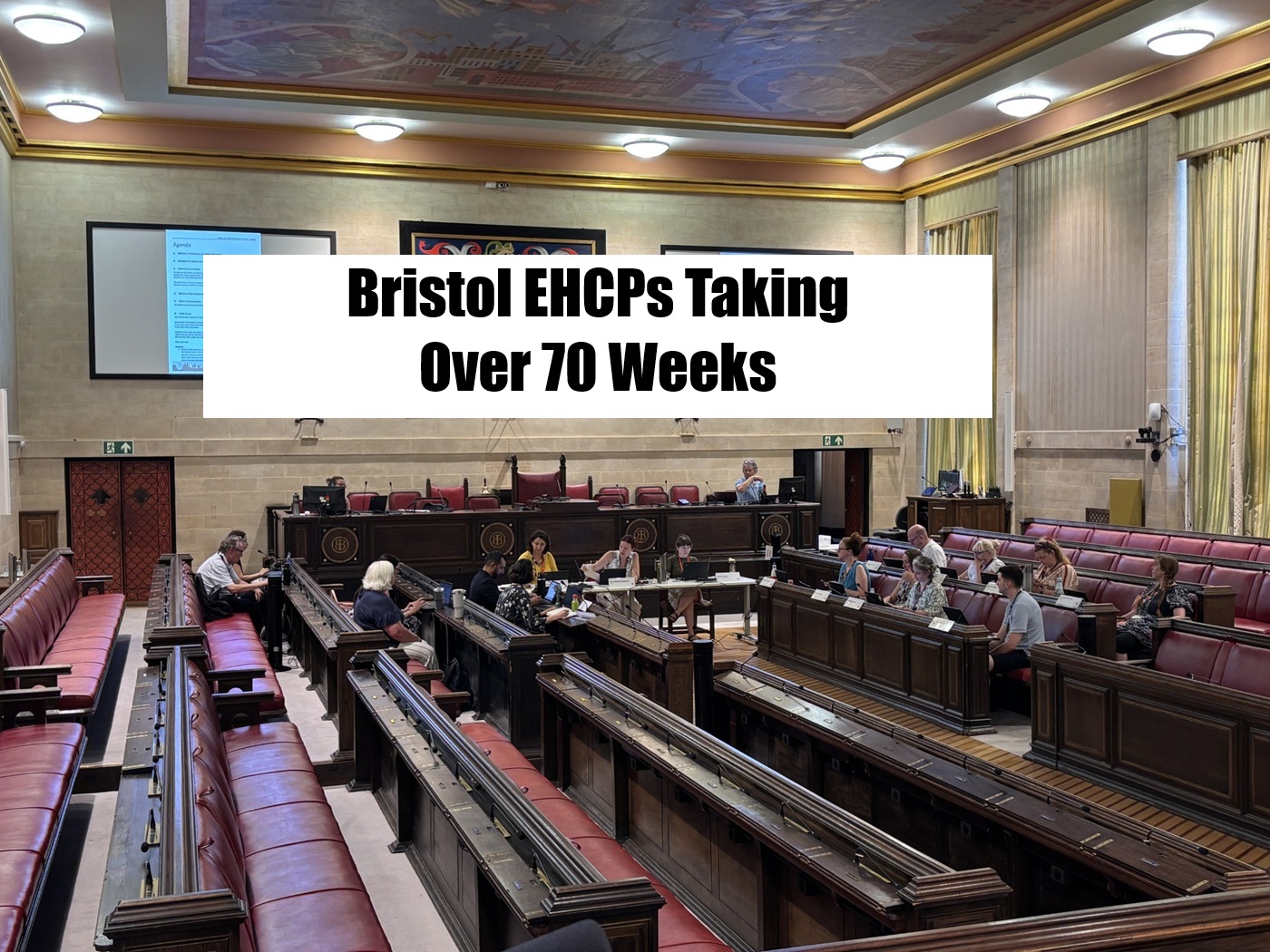
Bristol EHCP Wait Times Exceeding 70 Weeks
The legal time frame of 20 weeks is continuing to be missed for the vast majority of Send children and adults
- Bristol EHCP Update
- Some children and young people are waiting over 70 weeks for an EHCP
- Bristol City Council’s timeliness is at 17 per cent
Some families in Bristol are waiting over a year for an Education Health Care Plan to support their children or young people with educational provision.
It’s not currently clear how many young people who are care experienced are also effected by delays as the statistics do not break this down. This could mean there are teenagers through to the age of 25 who are battling complex legal processes alone.
The continuing lengthy waits were revealed in questions to Children and Young People Policy Committee this week.
Children and Young People Policy Committee Meeting
Children and Young People Policy Committee took place at the Council House on 25 June. As part of the meeting, data surrounding Bristol City Council’s performance around Education Health Care Needs Assessments (EHCNA) and Education Health Care Plans (EHCP) was discussed.
An EHCNA is when a school or family make a request through a legal statutory process to have a child aged from birth to 25 years go through an assessment of need regarding their Special Educational Needs and Disabilities ( Send).
An EHCP is the final plan which contains provision that must be carried out in law. A final plan must be issued within 20 weeks.
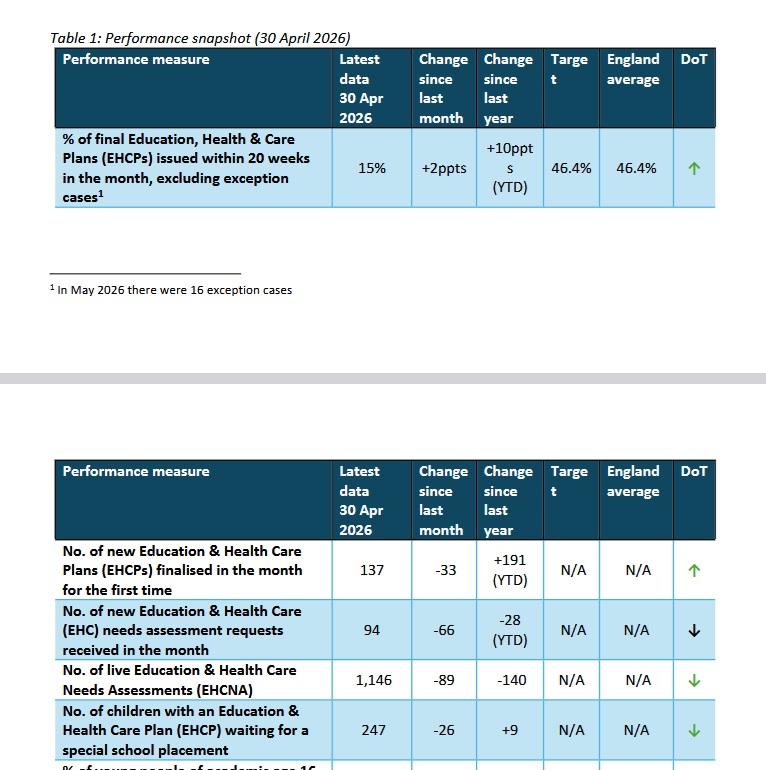
Ahead of the meeting this week, update report papers were published showing a ‘snapshot’ of the council’s performance on 30 April 2026. The percentage of final EHCPs issued within 20 months, excluding exception cases, was 15 per cent. The England average was 46.4 per cent.
The number of new EHCNAs requested in that month had actually reduced.
There were also 247 children and young people with an EHCP still waiting for a specialist setting placement.
Papers for the report say ‘There were 94 requests for Education, Health and Care Needs Assessments (EHCNA) in April 2026. We continue to experience as similar annual profile of requests and with a 6 per cent reduction in the number of requests for the (calendar) year to date compared with 2025. This means the backlog is showing marked signs of reducing as below. The rate of requests per 10,000 population in Bristol for Quarter 3 2025/26 was 21.9, in line with the national rate of 21.2, but below the South West rate of 25.7.’
The papers say that ‘Improving the timelines and quality of children’s EHCPs remains a priority.’
The local authority’s statistics also finds that 15 per cent of children’s plans finalised in April 2026 were within the 20-week timescale with year to date timeliness at 17 per cent compared to 07 per cent this time last year.
How long should an EHCP take from start to finish?
There are hard deadlines that local authorities must meet through the statutory duty in The Special Educational Needs and Disability Regulations 2014.
It says:
However, local authorities must finalist EHCPs with 20 weeks.
The only time the 20 weeks is relaxed is in specific conditions.
(2) A local authority must send the finalised EHC plan to—
(a)the child’s parent or to the young person;
(b)the governing body, proprietor or principal of any school, other institution or provider of relevant early years education named in the EHC plan; and
(c)to the responsible commissioning body,
as soon as practicable, and in any event within 20 weeks of the local authority receiving a request for an EHC needs assessment in accordance with section 36(1) of the Act, or of the local authority becoming responsible for the child in accordance with section 24 of the Act.
There are what is called ‘exception cases’ which have stringent criteria to meet.
The local authority need not comply with the time limit referred to in paragraph (1) if it is impractical to do so because—
(a)the authority has requested advice from the head teacher or principal of a school or post-16 institution during a period beginning one week before any date on which that school or institution was closed for a continuous period of not less than 4 weeks from that date and ending one week before the date on which it re-opens;
(b)the authority has requested advice from the person identified as having responsibility for special educational needs (if any) in relation to, or other person responsible for, a child’s education at a provider of relevant early years education during a period beginning one week before any date on which that provider was closed for a continuous period of not less than 4 weeks from that date and ending one week before the date on which it re-opens;
(c)exceptional personal circumstances affect the child or the child’s parent, or the young person during that time period ; or
(d)the child or the child’s parent, or the young person, are absent from the area of the authority for a continuous period of not less than 4 weeks during that time period.
‘Papers for the meeting also say that the progress against the council’s EHCNA Improvement Plan is monitored by Children’s Quality, Improvement and Performance (QuIP) Board.
‘It continues: ‘Following a 37 per cent increase in new EHCPs finalised in the 2025 calendar year, 512 plans have been issued between January and April 2026, a further 60 per cent increase on this time last year.
‘Educational Psychology output has also improved with a 20 per cent increase from 2025. This has contributed to the continued decrease in the number children awaiting an EHCNA, which now stands at 1,146 at the end of April 2026, down from 1,317 children at the end of January 2026.’
Latest data from the Department for Education
Data from the Department for Education (DfE) shows that in 2024, Bristol City Council issued 33 plans – including exceptions – after 52 weeks. In 2025, this shot up to 231.
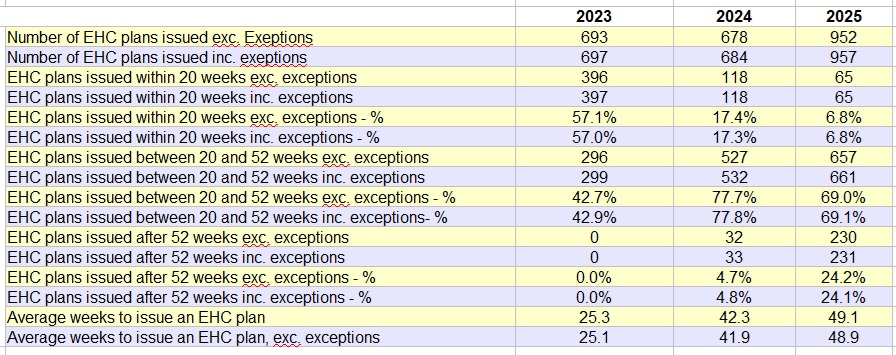
EHCPs are exceeding 70 weeks
Three questions regarding EHCPs were submitted to the June committee meeting.
The first regarded the timeliness of EHCPs.
The questioner asked: ‘Can the committee confirm how many Education, Health and Care Plans (EHCPs) are currently exceeding both 60 weeks and 70 weeks from the date the EHC needs assessment was originally requested, and provide a breakdown of these cases?’
Bristol City Council’s response was: ‘There are currently 24 live EHC needs assessments over 60 weeks from the original request date.
Of these, 15 are between 60 and 70 weeks, and 9 have exceeded 70 weeks. These cases are being prioritised through the EHCNA recovery work.
‘The reasons for delay vary; in 11 of the 24 cases, there has been mediation following either a decision not to assess or a decision not to issue an EHCP. The remaining cases form part of the wider backlog and continue to be treated as a priority.’
Question two regarded Top Up Funding. This is funding to support children and young people without an EHCP. It was cut by former Deputy Mayor Asher Craig in early 2024.
The questioner asked: ‘Of the 1,146 live Education, Health and Care Needs Assessments (EHCNAs) currently in progress, how many children and young people are in receipt of top-up funding, and what is the average top-up funding amount per child/young person?’
Bristol City Council responded: ‘At the time of writing (18/06/2026), there are 1,045 EHC needs assessment requests in progress. Of these, 32 children and young people are currently in receipt of top-up funding. The average amount of top-up funding for these 32 children and young people is £7,092’
The third question regarded the maintaining of productivity, asking: ‘With 137 EHCPs finalised this month, down by 33, why is the service unable to maintain stable month-on-month output?’
Bristol City Council’s response was: ‘As set out in our EHCNA Improvement Plan, monthly targets for finalising EHCPs reflect expected variations across the year. Targets are set at 170 plans finalised in full term-time months, reducing to 119 in months that include school holidays to account for the expected reduction in staffing capacity and the reduced access to schools and settings.
‘The figure of 137 EHCPs finalised relates to April 2026, when the target was set at 119 due to the Easter period and therefore exceeded our target by 15% in April. In May 2026, the service achieved its target with 170 EHCPs finalised.’
What was said in the meeting
Director of Education and Skills at Bristol City Council, Vik Verma gave a verbal update ahead of questions from the committee.
He said: “Bristol continues to face significant pressures. We have seen significant growth in the number of children we’re supporting through an Education, Health, and Care Plan. So over 6,000 as of today.
“Families tell us they still want to see more in terms of earlier help, more consistent mainstream inclusion and smoother pathways through the system when they need support.
“And delays in assessment and diagnosis remain a significant concern both in the health system but also in the EHCNA backlog which we’ll be able to update on through the update reports.”
Later he continued: “We’ve also been investing in services such as education psychology alongside our Send team to expand capacity in the teams and support schools more closely through our inclusive learning service but also ensure that we are meeting and progressing towards clearing our backlog of assessments and delivering more timely support to families.
“So as of today our backlog, the number of EHCP requests are the lowest in the south west region. So we’re getting a sense that the early intervention support that we are offering to schools is having an effect and is mitigating the rise in requests whereas nationally the trend is growth of EHCP requests.
“And our EHCP output in terms of the number of plans that we have issued as a local authority in quarter 4 which quarter four of the financial year – so closing in April – is the highest in the region and surpassing both the local and national average and we are seeing our backlog come down and anticipate that we’re on track to clear that backlog by the end of this calendar year if not sooner.”
“We are still monitoring timeliness. We know that’s not where it needs to be at the moment. So year to date 17 per cent of EHCPs are within the 20 weeks time scale. That’s an improvement on 07 per cent from last year and we expect that to continue to rise as the backlog comes down to more manageable levels as well.”
Continuing through his update, Verma said: “We are recognising a risk around workforce constraints. There are challenges in terms of the number of educational psychologists that are qualifying and speech and language therapists that are qualifying. Rising demand. So the government’s announcement is that the number of children with an Education Health and Care plan will rise from 5.3 per cent to 7.7 per cent before returning back down to current levels in 10 years. So there’s a significant process to go through where we will continue to deliver our statutory duties whilst also implementing the reforms.
“And then I think recognising that all of these reforms and the work that we’re doing will depended on parent carer confidence both in our work as a local authority and tangible improvements in mainstream provision where inclusion will be the key measure.”
Councillor Susan Kollar asked a question about the way data was presented in the update.
In his response, Verma said: “As at the date of the report, it was 1146 in live assessments. That’s come down to just above a thousand actually. So at the next committee, you’ll see that likely tip below a thousand.
Continuing he said: “What we’ve seen in Bristol is the level of requests for assessment from schools has actually come down to the lowest in the south west and our output is, in terms of the number of plans, we’re issuing is the highest in the south west. So that’s why we’re seeing the backlog come down quite significantly and is you know in line with the plan that we set out to recover that.”
For What’s On In Bristol: https://backstagebristol.com/
Bristol Culture: www.tiktok.com/@chopsybristoltt
Bristol Theatre Updates: https://www.facebook.com/backstagebristol
Bristol News and Culture: https://www.youtube.com/user/chopsybaby