
Talking to your kids is an artform!
By Tanith Carey
If the answer to questions like “What did you do at school today, darling?” or “How was work?” is generally “Stuff!” or “Not Much…”, it may well be that conversation is already a dying art in your family.
After all, emails, texts and social media mean we now spend more time corresponding through cyberspace than communicating face-to-face.
Now a new game aims to get us all talking again. Invented in Australia, where it has already sold 100,000 copies, the idea is deceptively simple.
The Art of Conversation, or TAOC for short, consists of packs of business card-sized cards with several questions on each side.
But though it may sound like Trivial Pursuit, the point isn’t to show off who knows most. Instead the aim is to find out how much you know about yourself – and learn more about the people around you.
The questions are as wide-ranging as: “What’s the best surprise you’ve ever had?” through to “What gets you through tough times?”
More than just being just fun, co-inventor, Louise Howland says that simply asking about subjects you’ve never had time to broach with your friends, family, partners or children can bring you closer.
Beyond that, proper conversation is also absolutely essential for children. Thanks to the advent of 24/7 technology, Louise believes that adults have got out of the habit of listening and talking – and ultimately it’s kids who are paying the price.
According to a recent survey by the Government’s communication advisor Jean Gross, it’s estimated that almost a quarter of boys – and one in seven girls – have trouble learning to talk because TV sets are left on all the time at home in a quarter of households.
The end result is that kids start school with a smaller vocabulary, shorter sentences and only able to understand the most basic instructions.
Louise, 50, a vivacious mum-of-one from Melbourne, Australia, who’s been in the UK to spread the word about TAOC, explains: “After all, we teach our children the names of the river and the continents.
“But we don’t teach them what’s most essential for a successful life which is how to communication so they can build good relationships.”
“As parents, we’re all so busy. The kids are going one way, we’re going the other – and we’re juggling all the time, so it’s often easiest to put them in front of a screen. Add to that the fact that kids are also spending more time in childcare, and the extended family is a thing of the past. We have to ask ourselves the question: Who’s talking to our children on a one-on-one basis.”
But if we only put a bit of effort to talk and listen to our children, the benefits are not only immediate, but life-long, she adds.
Letting children express themselves freely – and listening to what they have to say in a non-judgmental way, also does wonders for how they feel about themselves, says Louise, who regularly plays the game with her own 11-year-old, Rina. “It makes children feel important and validated to see that their opinions count – as well as helping the generations see each other in a fresh light.
‘When children play with their parents, you can see kids’ eyes light up to hear their grown-ups tell them something they didn’t know about their life or experiences. You can almost see them thinking: “Wow, Mum/ Dad really was a real person once!”
“But beyond that, there was a study done which looked for common denominators among high-achieving adults. The only common one they could find was that, as children, these people all had regular family dinners. We hope that playing TAOC will bring back some of those discussions that families used to have around the dinner table.”
In Australia, the game is not only used as an ice-breaker at parties, work conferences and homes. It’s also used as a therapy tool inside prisons and schools. It’s also been adopted by schools to get bullies and their victims communicating – and to help autistic children who need lessons in listening and making friends.
It takes two years to devise the right type of questions for each edition of the game – and they all go through rigorous testing to get the selection down to the final two or three hundred, depending on the edition.
Any query that makes players embarrassed or uncomfortable – or is that little bit too nosy – get axed. “What’s the most illegal thing you have ever done was dropped?” for scrapped for that reason because Louise didn’t want players to feel like they were on the other end of an inquisition.
The original idea for the game came from Louise’s partner, Norwich-born musician Keith Lamb. Keith emigrated to Australia in the early Seventies and became a household name there as part of a glam rock group called Hush. But when his fame waned , he found it hard to relate to other people. He had a breakdown and it was then that he met Louise, who was then working as a psychiatric nurse.
Since then the pair have become business partners and collaborated on more than six editions of TAOC – including one for children – and versions for food and travel lovers. It’s also been translated into French and German.
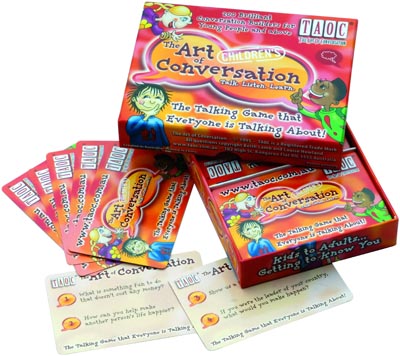
Although the idea may be simple, Louise said she believes TAOC helps changes lives – simply because communication is the source of all healthy human relationships.
“I had one woman who told me she didn’t talk to her husband about anything but the family schedule and the kids. As a couple, they didn’t have any proper conversation and didn’t know each other anymore.
“She didn’t feel her husband was interested in counselling or sitting down and talking either. So she organized a dinner for them to go out on a regular basis over the course of six months and she asked him some of the questions from TAOC – and they began to reconnect.
“I also heard from a dad who was in that horrible situation of having his kids infrequently – about every second weekend. When he saw his children, he found it really difficult to get that instant rapport because he didn’t hear about all the day-to day-things.
“So he started to use a couple of questions from TAOC every time he saw them again – and he found he and his kids were much quicker to getting back to being close and bonded again.”
So does Louise have a favourite question? She says not. But she does have a favourite answer.
“One beautiful little eight-year-old girl was playing the game and she got the question: When does a person become old?
“She answered: “When they stop making plans and keep leading the same life.” For me, that showed us how much we all have to learn from one another.”
To find out more about availability, go to www.taoc.com.au . It’s also available at www.amazon.co.uk priced £10.20