
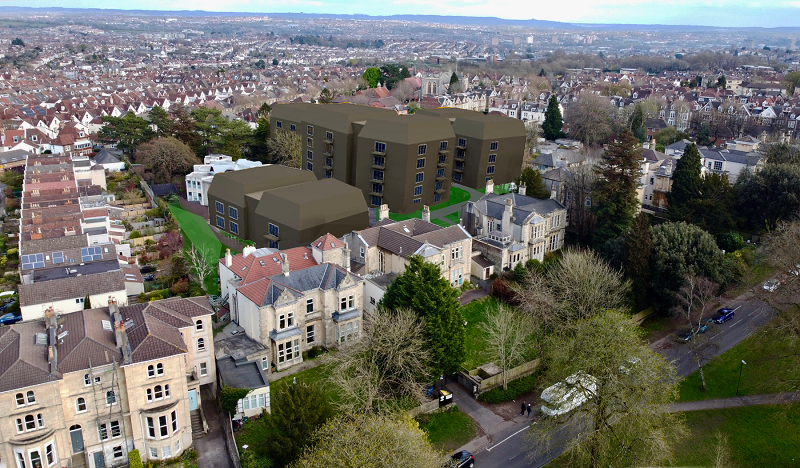
Bristol Planning Application Claims ‘multiplicity’ of Specialist School Places Despite Local Crisis
Bristol has a ‘multiplicity’ of specialist school places a developer’s report has stated despite a shortage of specialist places in the city.
The report by EFM Partnership Ltd and completed in February this year, has been submitted in support of turning a former specialist school into ‘retirement living’. EFM provide specialist advice and guidance related to the maintenance and development of educational establishments.
St Christopher’s School in Westbury Park, closed in March 2020, with the FORE Partnership acquiring the site in May 2021.
Campaigners desperate for specialist residential provision as well as those opposed to the development, formed St Christopher’s Action Network, standing against plans to turn the former residential site into a retirement facility. They say there is now no residential Special Educational Needs and Disabilities (Send) school in Bristol, with families forced to send their children and young people to placements out of the county.
A highly documented and reported critical shortage of specialist school places in Bristol has seen many children and young people with Send without access to education in the city over the past few years. The situation became so bad that Bristol Mayor Marvin Rees, was forced to promise an increase of 450 new places to meet need – although the full number of places has not yet been met.
But the EFM report says that ‘while numbers of pupils with special education needs and disabilities (SEND) have risen in the recent past and are likely to continue to do so within the immediate future, there is a multiplicity of provision to meet their needs across the area and only a small proportion of children need a special school place. With two new state-funded special schools opened in the City since 2016 (Venturer’s Academy and Soundwell Academy) and a support facility in the pipeline, it is anticipated that sufficient spaces will be available into the future.’
It also notes that ‘most areas also have “alternative provision” or pupil referral units, for pupils who are unable to attend school for behavioural or emotional reasons (among others) although these places are usually short term.’ This is despite a report finding 31 areas of improvement needed in the city’s Alternative Learning Provision (ALP). The ALP report also said: ‘Some ALP providers are at risk of turning into special schools but are not registered as such.’
The EFM report claims there are currently 170 spare places in the city, a number described by them as ‘high’.
But statistics released by the Department for Education last week found that in January 2022, there were at least 80 children or young people with an EHCP awaiting education provision or in arrangements other than school. A further 209 were not in Employment, Education or Training and 3 had an ‘unknown’ arrangement.
These statistics don’t show the number of children currently in Alternative Learning Provision with or without an EHCP, nor the 500 children or young people currently caught up in Bristol’s EHCP backlog.
Coming through the system are more autistic children who will need support with the education. Head of Children’s Service at Sirona Care and Health, Gerry Bates Told People Scrutiny in March this year that In the second half of 2021, referrals to the Autism Assessment hub in Bristol increased by 160 per cent, which Bates called ‘a huge increase in demand’.
At Bristol Schools Forum in March, Alison Hurley told members that of the 450 promised places, just 142 had been created in Phase 1 of the project with 20 more identified for Phase 2. With Capital projects the council has been working on and increasing the size of specialist provision, 282 of those promised places are predicted to be available by September 2023.
At the meeting, Hurley said: “We’ve delivered and got on the trajectory 282 places so far which is you know really positive and a huge thanks to all the schools and settings that have been involved in opening new provision and I’ve managed to get to visit some as well there’s some fantastic new provision that we’ve got across the city and also those that are still engaging and any new discussions that we need to have in terms of future projects and programs and I’ll be taking this slide to the head teachers’ briefing next week as well and really looking at how we can identify meeting that next phase in order to get to that 450.”
Hurley stated that they would be continuing to look at ‘repurposing and utilising’ space in primary provision as an option for specialist places.
Papers submitted for the same meeting also note the ‘rise in demand’ for specialist settings with a ‘large increase’ in the number of EHCPs. ‘The rise is significantly above that which would be expected from the rise in the general school population. Existing specialist provision across the city is at or very close to capacity and will require substantial capital investment.’
Regarding specialist school capacity, papers also report: ‘Although good progress is being made, providing suitable and sufficient Special Educational Needs and Disability (SEND) places remains a major challenge.’
But contrary to the information given regarding capacity by Bristol’s Director of Education, EFM say: ‘In summary, therefore, while the need for special school accommodation within Bristol has grown, the recent opening of two new schools has dealt with this need, and significant surplus places are still available in the area within those two new schools. Given the scale of recent new provision, the likelihood of a further new special school being commissioned in the near future is
low. With no further special school currently being proposed for the state-funded sector within Bristol, and unlikely in the near future, it is hard to imagine that the St Christopher’s site could be identified for use as a new special school in the short to medium term.’
It also concludes saying: ‘Within the Bristol area, the number of children with EHCP’s needing a special school place has grown since 2015-16 and two new state-funded special schools have opened within the last five years. These have provided 352 additional places for children with a range of issues including autism spectrum disorder, severe learning difficulties, speech and language needs, and social emotional and mental health problems. With approximately 170 places remaining unfilled for these needs in particular, there can be no requirement for further places within these specialisms at present.’
But SCAN campaigners say ‘the need for residential and respite care is huge’ and that there is an ‘increasing need for SEND accommodation in Bristol’
Chair of ResCare, The Society for Children and Adults with Learning Disabilities and their families, Anita Bennett says: “St Christopher’s was a day and residential school for children with Special Educational Needs & Disabilities for more than 70+ years. It closed in 2020. There is currently no residential SEND school in Bristol. Allchildren are sent to ‘out of county’ placements. Because Bristol cannot provide in-county residential care, it spends millions of pounds on out of county placement for pre-16s, and for post-16.”
As of this morning, there were well over 200 objections and counting against the development, with comments due to close on Wednesday 18 May 2022.
Featured Image: SCAN
More from Chopsy Bristol
Find us on Twitter: https://twitter.com/ChopsyBristol
.