Bristol’s Has “Significantly High” Safety Valve Deficit
An update on the agreement plan was heard at the council house this week
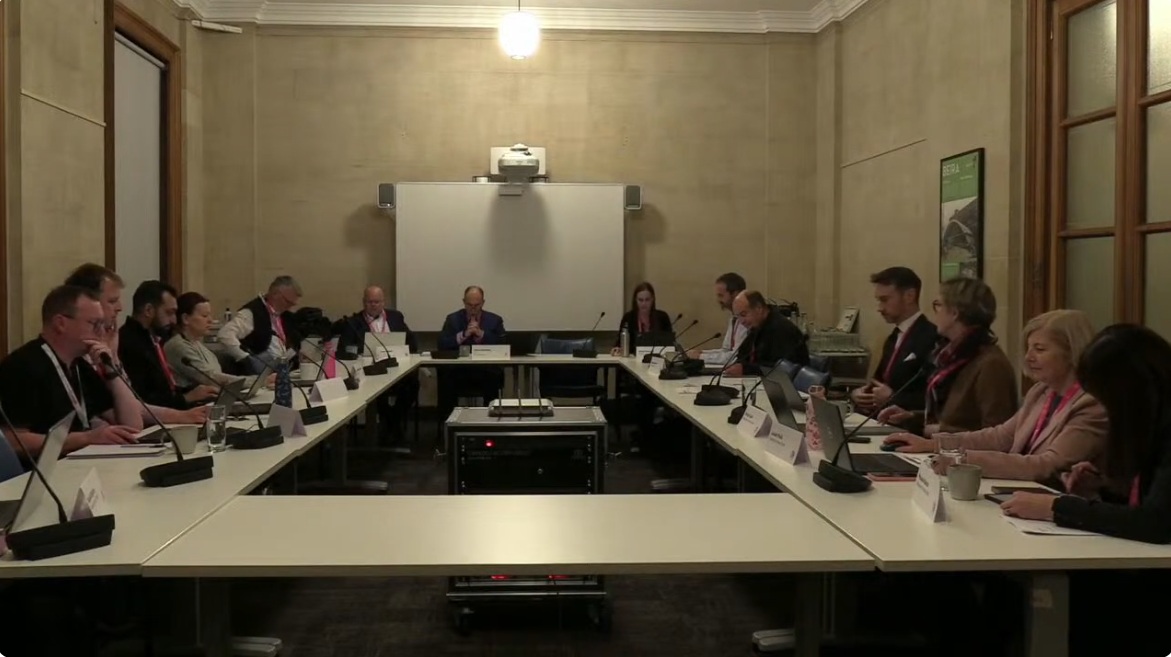
An update on the status of the Bristol Safety Valve agreement was discussed by Bristol educators at the council house this week.
Bristol Schools Forum heard that the overspend in the city’s Dedicated Schools Grant (DSG) was ‘continuing to grow’. The government funding is sent to local authorities for school running costs, Special Educational Needs and Disabilities (Send) support, Early Years costs and educational related services run by local authorities.
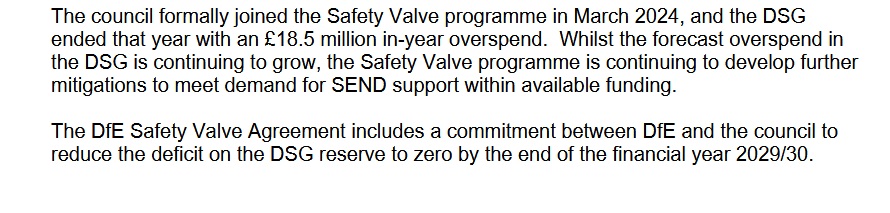
Bristol City Council says that although its overspend is “significantly high” the Safety Valve programme is developing ‘mitigations’ to carry out its Send responsibilities within ‘available funding’.
Who Said What
At November Bristol Schools Forum Simon Eakins of Cathedral Primary raised a question around the Safety Valve Agreement being off its original target.
Eakins has raised concerns about Safety Valve being off target in previous school forum meetings of November 2024 and January 2025.
This November he asked: “Just a kind of a question about the the overall position the High Needs Block. Obviously the Safety Valve was entered into 2024 was a five year programme to reduce the deficit. Do you have meetings with the DFE at regular points, you know, during that time?
“Because I’m pretty sure we are off where we said we’d be. But we do have, obviously, presumably do they not take any action until 2029/2030?
“What’s the critical date in terms of of action and potential risk? “
Director, Education & Skills at Bristol City Council, Vik Verma said: “So it’s triannual not quarterly. So there’s one quarter, and I don’t know why that is actually, but there is a quarter where we don’t submit. But three times a year, financial year, we submit an update on our progress on Safety Valve to the DFE.
“So our next submission is in early December. We meet with advisers from the DFE regularly throughout the year prior to those submissions to take them through both our progress in terms of the various policy initiatives that we are running. Such as the first condition for example which was to publish a strategy, you know, as an example alongside then a projection of what is happening to a Deficit Management Plan on the High Needs Block over the period.
“So generally we’ve received good feedback on progress we’ve made against the conditions. We recognise, I think, that the deficit is still significant, you know, it’s a significantly high deficit, but we also know that, my understanding, is that all local authorities that are part of Safety Valve are off track nationally.
“I think the National Audit Office did a report on this this calendar year and the national debt was on the High Needs Block across all local authorities, not just those with a Safety Valve Agreement was £8 billion.
“So that’s not to say that Bristol’s, you know, unique or special in that. It’s just to recognise I think that there’s pressure in the High Needs Block in probably three quarters of local authorities nationally.
“But I think where we’ve had good feedback, it’s been because of the progress we’ve made on the conditions on the way that we’re continuing to deliver our statutory duties and you know the improvement journey that we’re on.”
Simon Eakins asked: “I guess at a high level, what’s the main reason why we’re behind? Is it both a mixture of bigger draws on the funding, so like there’s just more need and so more income or more expenditures going out?
“Or is it more the delays in the mitigations, i.e., you know, it’s taking more time to get the additional places and things like that?”
Verma replied: “So there’s various I suppose downwards and upwards pressures. I think where we’ve seen progress, so we’ve seen a positive movement for example, we’ve been working really closely with our Parent Carer Forum and parents to look at children who would be able to return back to local settings for example through a supportive process. So we have a specific team that works really closely with them. We co-produced that strategy with our Parent Carer Forum. That’s been really successful.
“We set ourselves a target of returning 12 children back to local settings from independent settings. We broke that target. So we got to 22 children. And what we’ll be reporting to the DFE in our submission next week is that that saved £1.25 million pounds for example to the High Needs Block. So that is part of our downward pressure.
“We’ve also seen a reduction in the average cost of placement in various different categories and that’s been again part of the changing demographic of the children we’re supporting.
“So we’re seeing lots of positives there.
“We’ve also been able to profile in recent decisions at Children and Young People Committee to invest council capital in new schemes. That includes Throgmorton. That also includes St. Anne’s School and Henbury Court Schools are all part of that submission.
“So as those schemes become, you know, real and approved in terms of capital funding being put aside, that’s factored into my colleagues in finance’s Deficit Management Plan to show when that school will open and when we think that will have a financial impact on revenue. That’s a downward pressure.
“The upward pressure that we see is predominantly the Highs Needs Block hasn’t grown in line as you’ll know, in line with the growth in the cohort both in Bristol but also nationally. So where we’ve seen quite often year on year double digit growth, you know, over 10 per cent growth year on year, the budget hasn’t inflated by that amount. So that’s our most significant pressure.
“But also the number of children who are supported in independent settings as we know because of the capital position.
“We’ve still seen delay on the Trim Valley Free School which we’re hoping we’ll hear maybe some news on in the budget this week in the Autumn statement. But again that’s having a financial effect of about £6 million pounds for the revenue on the High Needs Block.
“And then the growth in our cohort, obviously we’re supporting more children. We’re meeting our statutory duty but that costs, you know, that costs funding to the High Needs Block to enable that to be given to schools to support.
“But you know we’re profiling those pressures through a set of assumptions around when projects will complete, what we think the forecast growth in the cohort will be. I think it’s as true a position as we can achieve with some of the assumptions and some of the unknowns nationally.
“Final thing I’ll say is that we know that there are reforms on their way early next year. We’re told they were due to be in the autumn. They will now be next year. So that may change the entire concept, context and landscape for us in this particular area of work.”
Chief Executive Officer of the Newman Catholic Educational Trust, Dr. Daniel Doyle for the Clifton Diocese said: “So just to build from that because there seems to be a lot of risk within the situation you’re describing. So maybe kind of talk to an aspect of the controls or the risk mitigation.
“You spoke about exceeding your target and returning some children back from the independent maintained. We can see in the budget there’s been an increase in there. So maybe that’s one area to focus on.
“Are there any particular boundaries, approval thresholds or parameters that you set to be able to try and control that? Or is it just that you’ve got to meet need as it comes in. And therefore it could be a bit of an uncontrolled uncontrollable?
Verma said: “So I think it’s a bigger question I think in terms of we have controls in place in terms of the way that we are measuring thresholds for example and where that need can be met. But fundamentally if we’ve got a child who requires a specialist provision and there isn’t sufficient places in the city or mainstream school cannot support those needs, the statutory duty on us as a local authority is to then support that child through another setting and that might be an independent setting and that bears significant greater cost than using schools like Briarwood for example or other local schools where we know that the cost to the High Needs Block is less.
“I think the the bigger challenge for all of us is how we promote stronger inclusion across the city and we can support more children through mainstream settings. I think that’s where we’ve set up an inclusive learning service to work with schools but also schools and trusts will need to think about themselves how they’ll be responding to the new Ofsted framework for example which has put inclusion at the heart of it. But also what the reforms might bring which we think will be you know a far greater emphasis on inclusion in mainstream.”
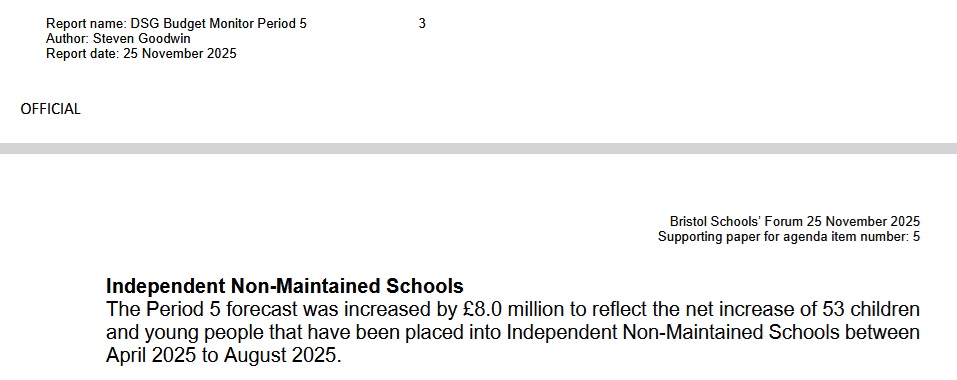
Bristol Schools Forum Chair and governor at NorthStar Academy, Steve Hornsby said: “I had one question and I’m not sure if it’s picked up in what’s been said there, which was this line about independent non-maintained schools. Where it’s talking about there’s an increase of 53 children and I guess is that a trend? Are there any actions to mitigate that?
“There’s a line in there which is saying independent non-maintained schools. The period 5 forecast was increased by £8 million to reflect the net increase of 53 children placed in the independent non-maintained schools. Just trying to sort of unpick that and understand that.”
Verma said: “I think we could probably bring some analysis to the next meeting of how we see the Deficit Management Plan forecast and what the assumptions are within it. I think probably what the paper’s trying to do is explain the movements between the last submission that you’ll have seen.
“What it won’t show is the number of children we’ve, you know, returned back into local settings, that children that have left the system because they perhaps you know they’ve turned 16 and maybe gone on to other other support other outcomes.”
Steve Hornsby said: “Well if we can have something in a sort of in the context and trend then it probably gives us a good picture rather than a snapshot.”
Verma replied: “Yeah absolutely and also I should say and I’m sure Steve will correct me if I’m wrong that where there are children joining system the £8 million pound effect is not a one-year effect. It’s the assumption that they will continue in that provision for the end of that phase of their education. I think that’s right isn’t it? So that’s why it’s a larger figure than you might be anticipating for 53.”
A technical issue with the live stream meant the end of the agenda item was not broadcast.
Home: https://chopsybaby.com/magazine/
TikTok: www.tiktok.com/@chopsybristolt
YouTube: https://www.youtube.com/user/chopsybaby