
Bristol EHCP Statistics 2026:
How does Bristol fare in the latest EHCP data and are we hearing the full story from the council?
The National Picture in England
The Department for Education (DfE) has released its latest statistics around Special Educational Needs (SEN) today.
The figures released contain both national and city-wide figures of the current numbers of Education Health and Care Plans (EHCPS).
Nationally, there is more than 1.8 million pupils in England with SEN. This includes both pupils with an EHCP and those on SEN support. This is an increase of 5.2 per cent since 2025.
The DfE says this has been an ‘increasing trend’ since 2016.
The percentage of pupils in England with an EHCP has increased from 5.3 in 2025 to 6.0 in 2026.
The percentage of pupils with SEN support (this means they have support but no EHCP) has increased from 14.2 per cent in 2025 to 14.8 per cent in 2026.
In England, the most common type of need for those with an EHCP is autism. For those on SEN support, the main need is Speech, Language and Communication Needs (SLCN).
Bristol EHCP Statistics
In the May 2026 meeting of Children and Young People Policy Committee, a question submitted by a member of the public asked how many weeks it was taking to get an EHCP.
In response, Bristol City Council said that in March 2026, it was 51 weeks.
The public forum papers pointed towards a page on the council’s website that said of its timeliness that ‘In Bristol, the range as of January 2026 was between 13 and 71 weeks.’
EHCPs should be finalised and issued within 20 weeks to ensure the council is compliant with the law.
Since the end of the Mayoral system in Bristol, Bristol City Council officers and politicians have been careful to avoid using the favoured words “unprecedented demand”. These words were often coupled with woeful excuses about why there were not enough specialist places in the city.
But are the city’s EHCP statistics really so surprising?
According to Bristol’s JSNA Health and Wellbeing Profile 2025/26, there are more live births than deaths in Bristol each year resulting in an increase in the population.
From 2014 – 2024, there were 56,300 births and 31,500 deaths. This resulted in a population increase of 21,800.
The number of births in Bristol increased gradually from 2000 onwards. By 2012, they had reached a peak. Since then, the number of births have fallen – with the exception of a slight increase in 2024.
This has caused a new problem – falling rolls for the city’s schools.
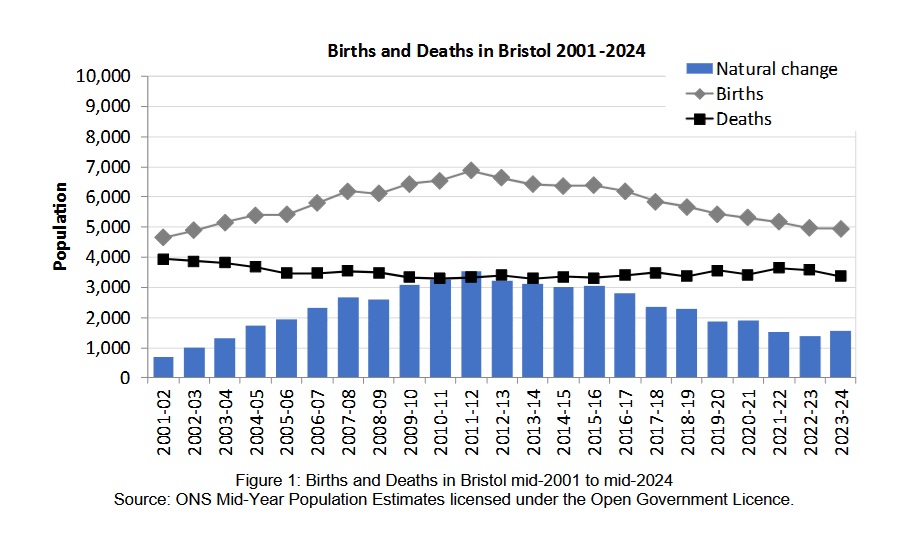
The birthrate rise during the years you can see in the table above was referred to in school placement contexts as the “bulge”. It saw an increased need in mainstream school places. Something that failed to translate in specialist places. In this context it was “unprecedented demand”
If there was a significant population growth peaking in 2012 and remaining high until 2016, that by 2022 – 2025, this would be translating into the number of pupils likely needing an EHCP or SEN Support.
Bristol statistics for these years have also been released by the DfE this year and this is what you find.
EHCP and SEN Support Statistics from 2018 – 2026 for England and Bristol
We have gone back to the academic year 2018 onwards to look at the rise in EHCPs and SEN support.
As you scroll down, you can see the figures for each year – along with a chart on percentages at the bottom.
2018/19
EHCP: 1,676
SEN Support No EHCP: 8,930
England National Average with EHCP: 3.1
Bristol National Average with EHCP: 2.5
SEN Support England National Average: 11.9
SEN Support Bristol National Average: 13.1
2019/20
EHCP: 1,778
SEN Support No EHCP: 9,285
England National Average with EHCP: 3.3
Bristol National Average with EHCP: 2.6
SEN Support England National Average: 12.1
SEN Support Bristol National Average: 13.4
2020/21
EHCP: 2,217
SEN Support No EHCP: 9,541
England National Average with EHCP: 3.7
Bristol National Average with EHCP: 3.2
SEN Support England National Average: 12.2
SEN Support Bristol National Average: 13.7
2021/22
EHCP: 2,531
SEN Support No EHCP: 10,207
England National Average with EHCP: 4.0
Bristol National Average with EHCP: 3.6
SEN Support England National Average: 12.6
SEN Support Bristol National Average: 14.6
2022/23
EHCP: 2,877
SEN Support No EHCP: 10,994
England National Average with EHCP: 4.3
Bristol National Average with EHCP: 4.1
SEN Support England National Average: 13.0
SEN Support Bristol National Average: 15.6
2023/24
EHCP: 3,243
SEN Support No EHCP: 11,345
England National Average with EHCP: 4.8
Bristol National Average with EHCP: 4.6
SEN Support England National Average: 13.6
SEN Support Bristol National Average: 16.0
2024/25
EHCP: 3,550
SEN Support No EHCP: 11,887
England National Average with EHCP: 5.3
Bristol National Average with EHCP: 5.1
SEN Support England National Average: 14.2
SEN Support Bristol National Average: 16.9
2025/26
EHCP: 4,040
SEN Support No EHCP: 11,907
England National Average with EHCP: 6.0
Bristol National Average with EHCP: 5.8
SEN Support England National Average: 14.8
SEN Support Bristol National Average: 17.2
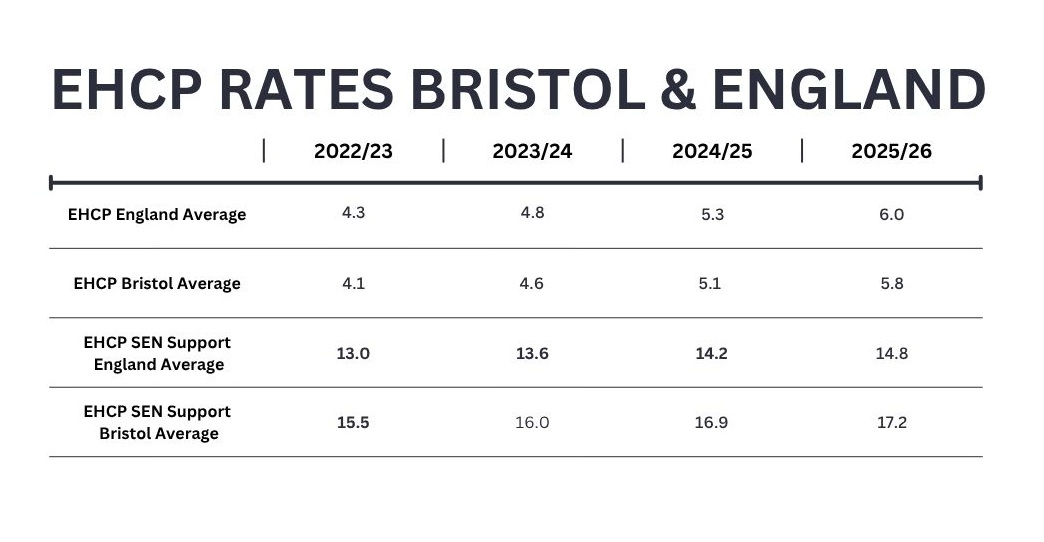
As expected, there is an increase in the rate of EHCPs and SEN support in Bristol which does marry up with the population increase. But, it’s worth noting that the rate of EHCPs remains below the England national average. It has never overtaken it.
The number of pupils requiring SEN support in Bristol is much higher than the England national average.
But in terms of that “bulge” of “unprecedented demand” how does it compare to the city’s population?
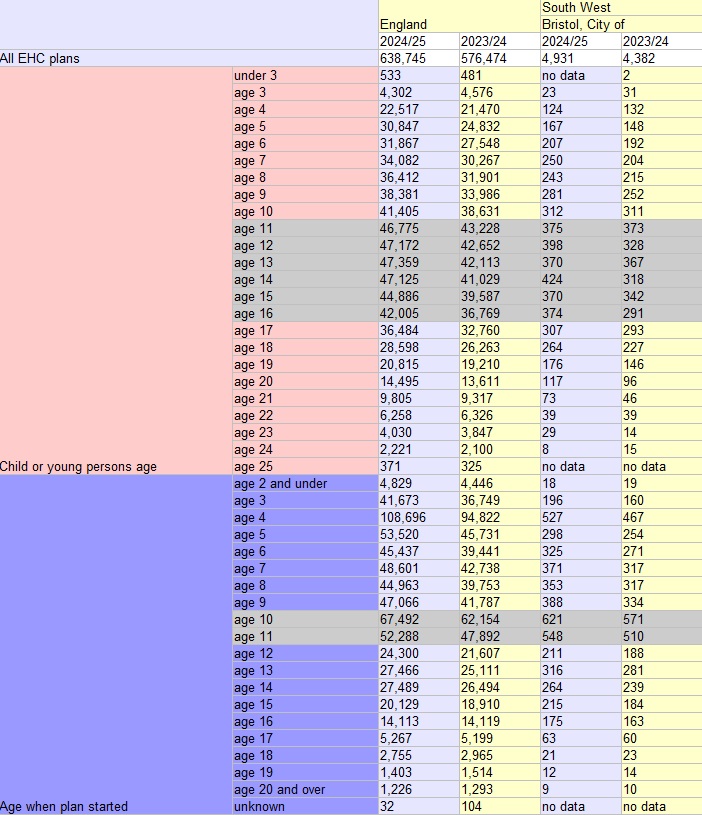
The grey boxes in the chart below shows numbers in 2024/25 peak for both EHCPs and SEN Support.
The peak in SEN Support is huge.
The academic year 2024 is ten years on from the 2014 SEN reforms. It is also ten years on from some of the highest birthrates in Bristol. It’s ten years on from parental campaigns pushing for Bristol City Council to increase the number of school places in the city for mainstream pupils.
This was always going to translate into the EHCP numbers. Typically, Send pupils who might be better supported in primary school soon found that from around year 8-10 they were going to need more support in secondary school.
And those send pupils who make the move to secondary without an EHCP, quickly found they were going to need one.
Of course, periods of time between 2016 and 2026 where pupils were and are waiting for EHCPs would see these issued in later school years.
Is autism the fastest growing need in Bristol?
If the constant media stories are to be believed, you can’t get out of your front door for tripping over autistic people, mobility cars and green lanyards. However, the stats present a slightly different story.
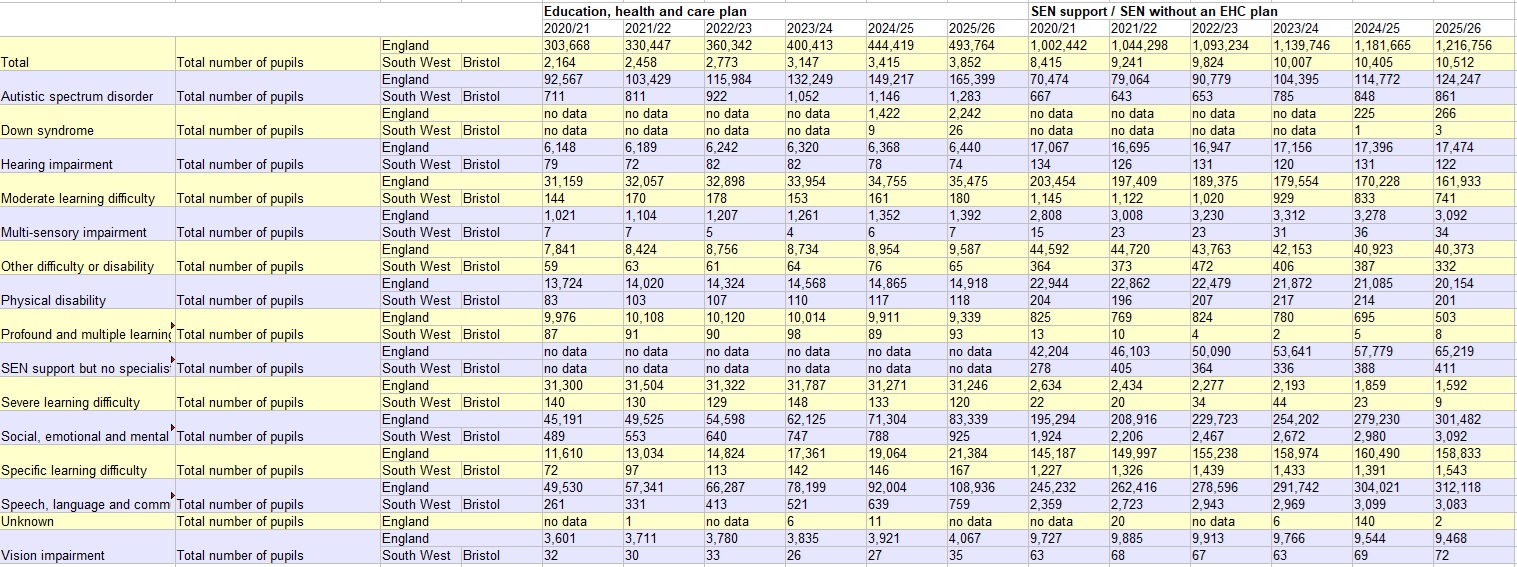
In Bristol, autism does make up the fastest growing need when it comes to EHCPs. But when it comes to overall SEN need in the city, it is vastly outnumbered by the number of pupils for whom SLCN is their main need.
SLCN makes up 759 EHCPs in Bristol. But for SEN support, it totals 2,359 pupils. This is a significantly higher number than autistic pupils.
EHCPS in Bristol by main need in 2025/26…
Autism: 1,283
SEMH- 925
SLCN – 759
SEN Support in Bristol by main need in 2025/26:
SLCN: 2,359
SEMH: 1,924
Autism: 667
The number of pupils with an EHCP with the main need of autism made up the following numbers:
2020/21: 711
2021/22: 811
2022/23: 922
2023/24: 1,052
2024/25: 1,146
2025/26: 1,283
The number of pupils with an EHCP with the main need of SLCN made up the following numbers:
2020/21: 261
2021/22: 331
2022/23: 413
2023/24: 521
2024/25: 639
2025/26: 759
The number of pupils on SEN Support with the main need of autism made up the following numbers:
2020/21: 667
2021/22: 643
2022/23: 653
2023/24: 785
2024/25: 848
2025/26: 861
The number of pupils on SEN Support with the main need of SLCN made up the following numbers:
2020/21: 2,359
2021/22: 2,723
2022/23: 2,943
2023/24: 2,969
2024/25: 3,099
2025/26: 3,083
Bristol City Council compares its education data to its statistical neighbours. This can become quite interesting when you are looking at things like EHCP timeliness.
For now, here is the EHCP rates for England and Bristol’s statistical neighbours.

And for England and Bristol’s literal neighbours.

Home: https://chopsybaby.com/magazine/
TikTok: www.tiktok.com/@chopsybristolt
YouTube: https://www.youtube.com/user/chopsybaby