

Bristol Alternative Provision Costs Escalate Due to City Wide Send Failure
Bristol Alternative Provision Pressures High Needs Block
‘High demand’ due to ‘persistent high levels of fixed-term exclusions for pupils with Special Educational Needs and/or disabilities (Send)’ is one of the reasons there has been a surge above expected spending in Bristol Alternative Provision (AP).
An increasing population since 2016 and the ‘sudden market exit’ of a Bristol AP provider in 2019 – Catch22, which was slated by Ofsted – has also been attributed to increasing pressure on Bristol City Council’s High Needs Block. The budget for AP within the High Needs Block has increased to reflect the demand, but there is already a £4.2m historic overspend on AP which will need to be contained within the block.
Council papers show that demand for AP is also high due to ‘increasing demand for specialist SEND/SEMH (social, emotional and mental health) places for children who have, or should have been assessed for, Education, Health and Care Plans (EHCPs), lack of special school places, inconsistent inclusive practice and infrastructure for children with special educational needs within the schools sector, lack of funding in schools for high cost interventions and specialist/pastoral support.’
The Commissioning Plan also identified that pupils from a BAME background in Bristol had higher rates of exclusion than those of other core cities.
Having AP is a statutory duty for local authorities, who must provide full time education for pupils who have been permanently excluded or for those with an illness or other complex reason meaning they are not able to attend traditional education settings.
The Alternative Learning Provision (ALP) Framework 2016 – 2021 was set up for five years with the option to extend for a further three years in yearly increments. The spending against the framework was originally estimated at costing £830,000 per year in the original commissioning plan, including 4 lots of 10 place block contracts worth £4.15m over 5 years.
This was based on the population projections and a needs analysis at the time. But there was no consideration of annual increases to the budget in line with population growth. It was also significantly less than the amount allocated to the previous framework from 2013 – 2016 which had been estimated at a total value of £1.634m per year – £5m in total.
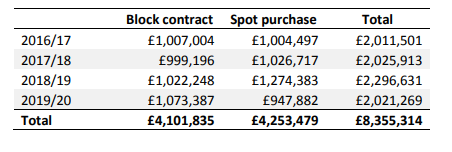
The total four-year spend between 2016/17 – 2018/20 stands at £8.355m, which is a £4.205m above the total amount set out in the Commissioning Plan.
Under current arrangements, the ALP framework can be extended up to August 2024, though Bristol City Council are choosing to extend by one year – to August 2022 – to complete a ‘collaborative’ commissioning process. This, they say would also allow for ‘more rigorous’ contract monitoring which would lead to increased attendance levels.
Demand for AP in Bristol, according to census figures submitted to the Department for Education stood at 212 places in January 2016. By January 2017, it had risen to at 221 places. By January 2018 it had rocketed to 360. January 2019 saw a drop to 146 again before a sudden surge to 318 places by January 2020.
The 2016-21 Commissioning Plan was designed to set up a more ‘flexible framework’ for AP which would allow for new providers to join and ‘improve quality assurance’. It said: “Approximately 2.12 per cent of the Bristol school population currently requires ALP, however the increased school population is likely to impact on demand for future ALP in other ways. As schools get fuller, class sizes tend to grow with tutor group sizes of up to 30. This can mean there is relatively less support available, leading to more need for alternative provision.”
But in September 2019, Bristol City Council Alternative Learning Provision Hub published a letter of advice to Alternative Providers and Commissioners of Alternative Provision saying: ‘Following recent enquiries from Ofsted HMI and engagement with the DfE, we are taking steps as a Local Authority to ensure that APs operating in Bristol are operating lawfully. We are attempting to address concerns about full-time education of children being made by individual or several different APs where such provision should be made in a school and, in some cases, where AP is being used as the sole education offer for children without having independent school status, registered with the DfE… Children should not be attending long-term unregistered AP for the majority of the school week.’
In its report to Cabinet, Bristol City Council says it is challenging high levels of exclusion and lack of special school places through its Written Statement of Action (WSoA) to Ofsted and the Quality Care Commission (CQC) after their findings in November’s joint Send inspection. Bristol City Council Education & Skills Directorate is running an ongoing review into specialist education provision and will shortly be releasing its Belonging Strategy.
July’s Cabinet is being asked to note additional spending on the ALP framework with approval sought to procure and award any additional block contracts required under the framework, extend the ALP Framework and existing block contract arrangements in line with contract terms and take up any extension options.
It is being asked to approve an increase in the framework value for the current year and subsequent annual extensions at £ 4.2m (historic overspend) and a maximum of £4m per annum for 2020/21 and 2021/22.
More from Chopsy Baby
Subscribe on YouTube: https://www.youtube.com/user/chopsybaby/
Follow us on Twitter http://www.twitter.com/chopsybristol
Home http://www.chopsybaby.com