
Letter to Ambassador Theatre Group Regarding New Access Policy
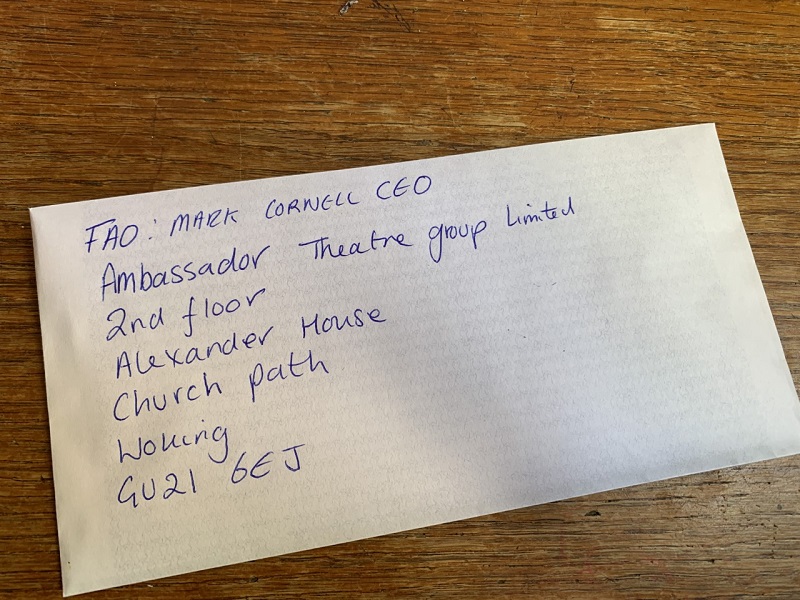
Last week, people on the ATG Access scheme received an email informing them that Nimbus Disability will now be handling accessibility arrangements. I have some issues with the way this will affect disabled people differently. As a neurodivergent family in Bristol, I felt so strongly about some changes to the scheme, I managed to actually find an envelope and will later on track down a stamp to send my concerns directly to ATG. I don’t know what other people’s ADHD is like, but I’d sooner find it easier to travel the world without technology than try and locate an envelope and stamp for a letter. And then post it. By doing this, it means that I am really concerned about the impact on disabled families and need to say something about it.
Dear Mr Cornell,
Re: ATG’s new accessibility policy
I am writing to express concern regarding some of the aspects of ATG’s new accessibility policy running in conjunction with Nimbus Disability.
Whilst it is welcome to see accessibility policies refreshed and potentially improved, it is highly concerning to see the vital role parent carers play in enabling disabled children and young people to access theatre, being eroded under this new access scheme.
Disabled children and young people are entitled to Disability Living Allowance (DLA) – inline with adults who receive Personal Independent Payment.
The government themselves describe DLA as being for a child who ‘has difficulties walking or needs much more looking after than a child of the same age who does not have a disability.’
The key here is ‘much more looking after’. The threshold for being awarded this benefit is extremely high and it is not easily given out. There has to be a huge amount of evidence relating to a child’s complex needs and the amount of care given around the clock.
Disabled children and young people can have extremely high and complex needs. These are children who are likely to receive an Education Health and Care Plan which will follow them until the age of 25. This will have specified and quantified educational, social and theraputic care in packages assembled by professionals such as educational psychologists, Occupational Therapists, mental health professionals and paediatricians.
Often children will require 1-1 support, need to access specialist settings or even have a package of education delivered into the home by the council because their disability is such that schools can’t meet their needs.
The care these children and young people receive greatly exceeds that which is given to non-disabled children as part of day-to-day parenting.
Sometimes these needs are so complex that the child or young person is unable to access theatre at all.
So it is really alarming to see in your new access policy that: ‘Nimbus are unlikely to offer Personal Assistant or Essential Companion tickets for children, where they would always be required to be under the direct supervision and guidance of a parent, guardian or other responsible adult.’
This entirely misses the point that when attending the show, parent carers are there in a carer role not a parenting role. They are meeting the needs of a disabled child or young person who needs support in the run up, before, during and after the show has happened.
The role of parents as carers is recognised by the Department for Work and Pensions. When parents claim DLA for a disabled child or young person, they are eligible for Carers Allowance. This is to provide care and support over and above day-to-day parenting. Parents often need to give up work to become carers. The £69.70 they receive each week for providing round the clock care does not go that far.
Being a parent carer in itself is not a protected characteristic. But when they are looking after someone who does have a protected characteristic – such as a disabled person – the Equality Act 2010 applies. It means it is illegal to discriminate against a parent carer because of their responsibilities as a carer or against the individual they are looking after.
The point is, that being a parent carer is not the same as being a parent, yet Nimbus Disability treat them as one and the same when they are not. There is a clear distinction. ATG by accepting Nimbus’ companion criteria is now doing the same.
Attending a show as a parent carer means a disabled child or young person is able to access the theatre. This involves advocating for their needs, being on high alert throughout the performance, maybe leaving the performance, liaising with staff about things in the show that might cause issues, calming a meltdown. The list could go on and on.
On one occasion I took my own child to an ATG theatre this year, we ended up watching the entire show at the back of the grand circle whilst sat on the floor peering through the gap in the aisle. Never mind we couldn’t see most of the stage. This was the way my child was able to access the performance. I had to make sure whilst we did this that she was comfortable, not causing a blockage, not annoying other patrons, making sure she had disability aids to hand and keeping her calm.
I strongly disagree that this is attending the theatre whilst parenting. This is attending the theatre whilst being a carer. It’s hard work, uncomfortable, but necessary.
I have always been impressed with the level of support we have received from ATG front of house access staff at our local theatre, the box office and other venues in London. They can’t do enough to help us.
But I’m surprised that this has not been raised as an issue in focus groups and with DPOs ahead of the change in access policy.
However, from my experience as a disabled family in Bristol – along with many others I know in the community – I’ve found that neurodivergent children, young people and their families are rarely equally represented in these discussions. This means yet again they face more access barriers impacting upon their lives and making them that bit more harder and unbearable.
I would kindly ask that you reconsider this aspect of the ATG access policy to ensure that disabled children and young people are able to access going to the theatre and that -inline with non-disabled people – they are given the opportunity to be theatre-goers of the future.
Yours Faithfully
Jennifer Smith