

“Really Good” EHCP Timeliness in Bristol Despite Year Wait
Bristol Councillors fail to pick up over 100 children and young people still haven’t had a finalised EHCP after a year of waiting
“Really good” signs of progress with the timeliness of Education Health and Care Plans (EHCPs) was almost the message from Bristol City Council in April.
The comment was made by Hannah Woodhouse, the Executive Director of the Children and Education Directorate, at April’s meeting of the Children and Young People Policy Committee meeting.
Woodhouse was about to start on the timeliness aspect of the Update Report of EHCPs, saying there was “really good” signs of progress, though managed to stop herself from finishing the sentence.
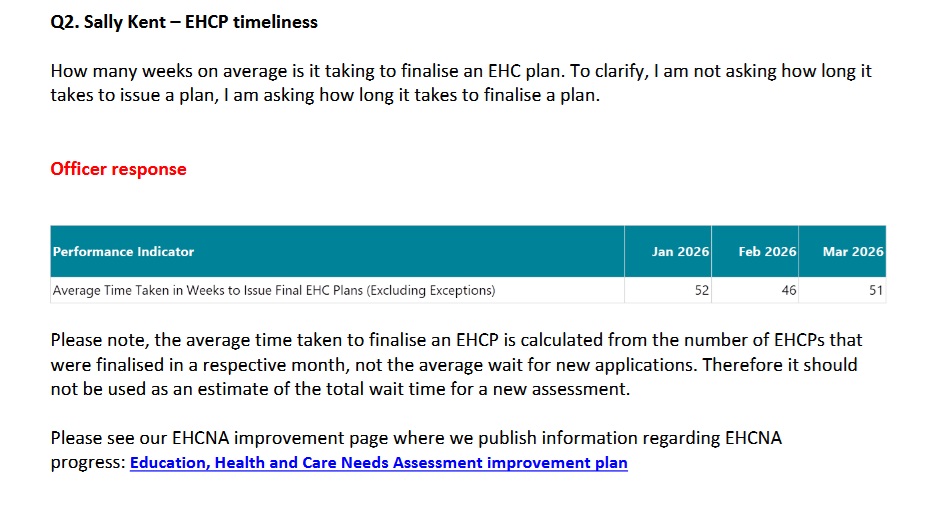
Public Forum papers for the meeting shows that the length of time for EHCPs to be finalised is still hitting the one year mark.
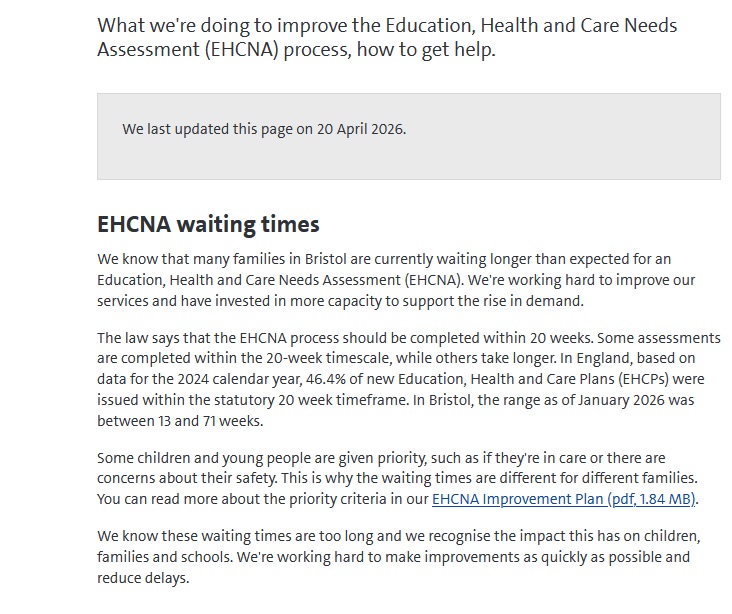
In an answer to a Public Forum question, Bristol City Council linked to its Education Health Care Needs Assessment Improvement Plan page.
The latest update to the page was on 20 April 2026.
It said: ‘The law says that the EHCNA process should be completed within 20 weeks. Some assessments are completed within the 20-week timescale, while others take longer. In England, based on data for the 2024 calendar year, 46.4% of new Education, Health and Care Plans (EHCPs) were issued within the statutory 20 week timeframe. In Bristol, the range as of January 2026 was between 13 and 71 weeks.’
Any plans that are finalised outside of a 20 week time period have been done so unlawfully.
A second question in Public Forum asked how many applications are currently over 52 weeks and not year finalised.
The response was that there are 115 EHCNAs that are over 52 weeks and not yet finalised.
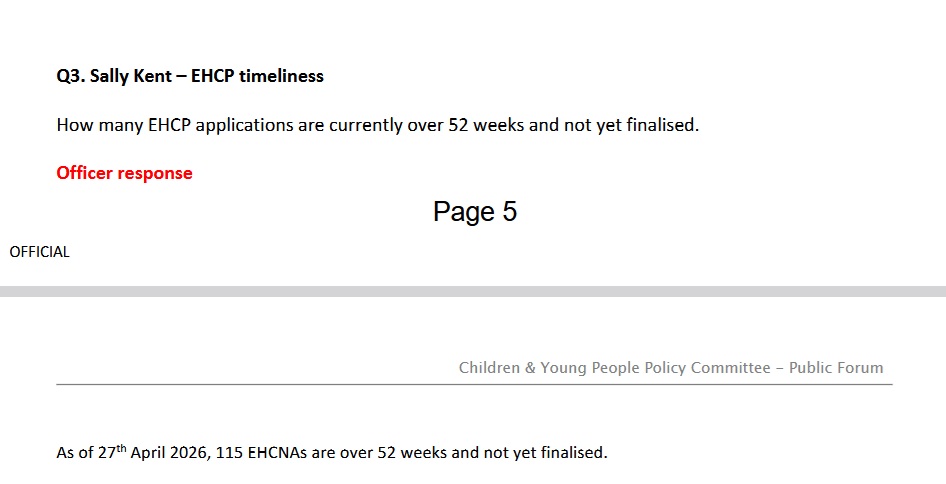
The shocking data was in the papers circulated to councillors ahead of the meeting, but no councillors raised the issue in the meeting.
What was actually said in the Children and Young People Policy Committee Update Report:
Hannah Woodhouse on EHCP Timeliness: “There’s really good, well there’s better, sorry I won’t say, but definite signs of progress in terms of our assessments of Education Health Care Needs Assessments in the data.
“So in March in the data we saw a 31 percentage point rise in terms of the speed of assessments. We saw a reduction in the the number of assessments waiting and an increase in those that were finalised in the month as well.
“So we are seeing, we are definitely seeing progress in the work and I just just want to recognise the work of the team, which continues to obviously be very challenging and recognise the context in which we’re working to support parents who are, and young people who are waiting and we are seeing progress there.”
During councillor questions for the agenda item:
Liberal Democrat Councillor for Brislington West, Andrew Varney said: “I just wanted to pick out two of the performance measures. So the first one is the the number of children with EHCPs waiting for special school obviously that’s increased.
“I’m just wondering while children are waiting for specialist placements, is there any sort of additional help that we give those children those families during that period of time?
Director of Education and Skills, Vik Verma said: “So a number of those children will already be in a mainstream setting with additional support to support them whilst they are waiting for special.
“So a large number of cohort will be awaiting a special placement but won’t be without education and then some may also be being supported by alternative learning provision so there is support in that respect, particularly as sufficiency grows and we see more places coming online.”
Verma also said that there will be “more places” coming with the opening of a new provision due to expand by September 2026. He added that those who are not receiving “sufficient education” are being tracked “quite closely”.
Labour Councillor for Brislington East, Tim Rippington asked: “I’m just wondering why why the target is the average rather than the 20 weeks which is the statutory timescale for those?”
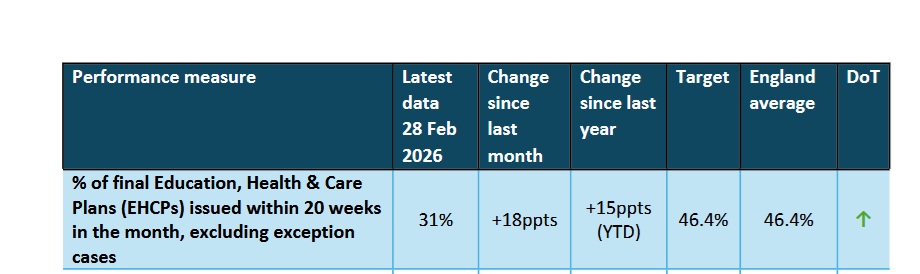
Verma replied: “So I’m fairly sure our corporate reporting the target is 100 per cent. That’s probably incorrect actually but we do track the national average, the England average which I think we recognise has been declining as well.
“And whilst we’ve seen some improvement in our performance against 20 weeks it’s still not average at that point. So I think we’re absolutely striving for 100 per cent. I think we’re realistic in the sense that from where we are with the backlog of assessments that are there it will take time to clear that backlog and get to a position where 100 per cent can be done on time. Recognising there are changes under way in 2029 when the thresholds will shift quite dramatically. So I think the first milestone for us is to get back to national average and then grow from that point.”
Councillor Rippington said: “Yeah, I can understand the benefit of you know looking at the national average but I would have thought target would be the statutory limit. Just on that as well it says excluding exception cases. Would it be useful to just know how many exception cases there are on a regular basis so that, you know, because that could exclude a significant number or it could be four.”
Verma replied: “It’s typically a very small number just to give some reassurance I don’t have exact figure but it’s usually tens as opposed to hundreds.” And there’s some very specific criteria set by the DfE.”
Children and Young People Policy Chair, Councillor Christine Townsend said: “I just want to come back to you Tim on the sort of a couple of these. So the 20 weeks. if you’re aware of any local authorities that are 100 per cent 20 weeks, please please let us know because the only one I’ve ever known is the city of London and that’s probably because they haven’t got any kids. It’s mostly businesses.”
Labour Councillor for Bishopsworth, Susan Kollar asked: “I wanted to look at the rise if you like in the number of EHCPs being finalised and I’m really pleased to see that rise. I can acknowledge from responses that I’ve personally had as councillor looking after when people got concerns that the communication is definitely improved. And I think that was one of the biggest issues was around communication.
“I think there’s been, a you know, quite a good sort of like upsurge in that communication amongst officers and councillors from my own experience.
“However, my question is, is that because we’ve now managed to get in more staffing to work on the EHCPs such as speech and language therapists and educational psychologists? Because I know that that must be something that at one point we had a bit of a thing about. I just wanted to know how are we achieving this in terms of, because I’m really happy to see it, but what we doing right that we need to continue and how you kind of keep that so that we don’t start dropping again?”
Chrstine Townsend said: “Focus and investment but I’ll let Vik speak to it.”
Verma said: “I think firstly thank you because I think the team firstly worked really hard and you know I think want to do well for children young people in the city and have worked really hard at that.
“The approach we’ve taken has been to make sure whatever we do is sustainable and isn’t just about throwing lots of resource in and and trying to solve the problem quickly but leaving problems down the road. So we did redesign the service which did involve some additional capacity in some key areas.
“We’ve also been looking at ways of working and processes. We’ve been looking at the support services and how health can contribute their assessments as well as our educational psychologist. We have increased the number of educational psychologists as well.
“I think you know it’s been a number of things. It’s not been purely just about investment. It has been also about ways of working.
“I think the team has been under sustained pressure for quite a long period of time and I think that the national reforms coming you know again there’s some pressure around that. A big part of it is, you know, they do really care about the work they’re doing. They are really passionate about it. They’ve got some better tools now, they’ve got some more capacity now in the areas that they need it, but it is also going to mean they’re going to keep working at the sustained level for at least the remainder of this kind of year to get the backlog down and I think it was great when in March they hit their target of 170 which is what we presented our aim was at this committee in September and I think there’s a different feeling in terms of what the team can do but we are always looking at how the team can be supported and there is still lots of work going on in terms of processes and ways of working that will continue because even with reforms there will still be EHCPs. So it’s important to recognise it will be featuring services…
Councillor Kollar said: “Going back what Tim said earlier about targets and how we’re currently matching the English average. That given the step in the right direction that we’re going and you saying about being able to sustain that it looks as though we’re going to be pushing above the national average. Would that be an idea of where where we’re kind of heading in terms of the sufficiency and the continuation of the work that you are doing? And that we might be pushing up as well?”
Verma said: “Yeah, I think there’s two things I suppose and the data sometimes doesn’t give you the the full picture. We’re watching the decline of the backlog of I think over two or three months we’ve started to see that decline and that’s the first time in in a long time now that it’s been coming down and again because they are hitting their targets around that. That doesn’t always speak to timeliness because a number of families have been waiting a long time in that process. So we’re not anticipating a sudden jump in in timeliness I think again. It will be part of a gradual improvement.
“My hope is that when we get to January 2027 we see backlog reduced down to a more manageable level And we do then see timeliness improve at that point. But we also need to be mindful of over the next few months what reforms are, you know, being communicated more widely and different changes being announced what effect that might have on the number of requests we receive and whether that will bring a different pressure to the service because we’ve modeled our improvement plan on the forecast of what we expect in terms of number of requests and deviate significantly from that it will have an impact on the service.”
Kollar said: “My second question is with regards to children who have got the EHCP and them not having a special placement, but while they’re waiting, I’m aware from some of the work I’ve done is that they’re not just being left. There is special provision. So what kind of special provision extra stuff are we doing in that interim? Because although they may not be enrolled on a school, something’s happening isn’t it?”
Verma replied? “So if they’re in a mainstream school?”
Kollar nods.
Verma continues: “If a child’s in a mainstream school but is awaiting a specialist placement it might be additional TA teaching assistant…”
Kollar interjected: “No I mean when they’re if they’re unable to go to school. So even if they’re they could be enrolled on the school but unable to attend because they’ve been suspended etc or for whatever reason parents aren’t sending them to school, there’s that additional sort of like tutoring and other provisions that mean that a child is being offered that extra support or the family is being offered extra support. We’re not talking about oh well they’re not involved with school, they don’t have a school placement, oh well never mind. We don’t that do we? We have additional stuff? Alternatives? There is that what is being offered as well?”
Verma said: “We do yeah. So if a child doesn’t have an education health and care plan but is being supported through alternative provision that would be working with one of our teams. They will work with the school where, you know, which may be either the last school that they were in or the school that they’re not attending at that point. And there’s a combination of offers. So that might include in -reach where we might offer some provision that could go into the school to support the child or possibly off-site alternative provision as well. And there are some children we’ve got to match the provision with with what’s going to work for them. So if they have emotional based school avoidance or they’re struggling to get to school, it’s thinking about you know what is the hook to support them to re-engage in education. But also where are the health services supporting them as well.”
Christine Townsend said: “As we’re talking about specialist places that we know children’s needs show us that they are remaining absent. We’ve had our capital programme, but we are still waiting for the Department for Education to give us permission and the capital to start building the Trim Valley special school in Southmead.
“They they asked us what we wanted to do just before Christmas. Do you want £8 million or do you want to build the school? And we said we want to build the school and pretty much we’re still in that place.
“Under the Safety Valve Contract, the Trym Valley Special School was supposed to be opening this coming September. And that gives us some indication of the difficulty we’re going to have at meeting both well at keeping our deficit down because we’re now circa £9 million plus, as a result of the delay on that school. And that just goes up every single day. But it’s not we’re not hearing from the Department of Education. So that’s a difficulty. But most importantly, those children haven’t got those special school places that we know that they so desperately need. But we can only progress the things that we are in control of. And so therefore that capital program is something that we keep a very fine eye on and making sure that that’s moving at the speed at the maximum speed that is physically and humanly possible given there’s lots of other constraints that exist around building new stuff in the way that we know that that those things occur.”
Home: https://chopsybaby.com/magazine/
TikTok: www.tiktok.com/@chopsybristolt
YouTube: https://www.youtube.com/user/chopsybaby