
Squiffy Teddy Does…The Regional Spatial Strategy for the South West

The green and pleasant land of England’s beautiful South West countryside is under siege. It’s not the only place. Across the country, pockets of communities are coming together to protest against The Regional Spatial Strategy (RSS).
The RSS is a government policy which is supposed to contribute to a region’s future sustainable development, transport plans and housing for a fifteen to twenty year period. It’s already late. Due out in June this year, it has been held up by legal wrangles.
The RSS for South East England has been involved in legal challenges from the Oxfordshire branch of the Campaign to Protect Rural England (CPRE), Guildford Borough Council and South Oxfordshire District Council, who are challenging Oxford City Council’s proposal to build 4,000 new homes on green belt land in the area.
The RSS for the South West proposes building 500,000 new homes in the region. Bristol, South Gloucestershire, Bath and North East Somerset and North Somerset would get 117,000 new homes. This will happen despite an estimated 60,000 empty dwellings in the South West region. Back in March, the then Housing Minister Margaret Beckett asked councils to take firmer action and gave them stronger powers to deal with empty homes with the Empty Dwelling Management Orders (EDMO).
As well as this, Bristol City Football Club (BCFC) is looking to build a new super stadium on green belt land bordering South Bristol and known by local residents to flood. This would be funded mainly by selling the current Ashton Gate site to a food retailer. BCFC are working with Tesco who have submitted plans for a new 24 hour superstore, something that many local residents are objecting to. The new football stadium is instrumental in securing Bristol as a world cup venue for 2018.
Local campaign groups believe the RSS over estimates the amount of new housing that is actually needed and that the figures are already out of date with the current economic climate. Not only this, but it actively encourages developers to seek out green belt land because is cheaper to develop due to VAT and it has no previous development to clear except fields and wildlife.
In some areas such as the land being fought for in Warmley and Siston, the developers who purchased the land for development were the same people who carried out the initial survey for the RSS, telling the government how many houses are needed in the area and exactly where to build them.
The concept of green belt land came about for precisely the reason that communities are now coming out in force to stop its destruction – to stop the urban sprawl of cities swallowing up the countryside.
In the South West, these areas are being fought for by Save Our Green Spaces, a coalition of local campaigns and organisations coming together to protect green spaces by fighting the RSS and other inappropriate planning proposals.
Chopsy Baby asked representatives from some of the local action groups to tell us a more about what they are doing and why it is so important?
Dundry Residents Action Group
www.saveourgreenspaces.org/drag_index.html
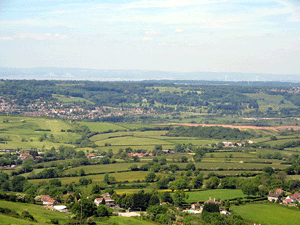
Photo DRAG
Chair of the Dundry Residents Action Group (DRAG) Debbie Nicholls said:
“We as a group now work with other local groups around our village such as Yanley, Uplands, Highridge and Bedminster Down to name but a few. We were also instrumental with Warmley/Siston and Shortwood in forming our new group Known as SOGS: Save Our Greenspaces. There are now around 35 groups on board all dedicated in saving our Greenbelts and spaces.
“North Somerset are dealing with an application submitted by Baker Associates who work on behalf of the Developer Land Trust. This is an application to build 9500 plus dwellings all on greenbelt land and is to become an urban extension to Bristol which has been named Ashton Park. Application no: 09/1455/0T2
“We object to this application on a number of issues some of which are:
“Firstly the application is premature: Draft RSS has not yet been finalized over 35 thousand responses were received from the people in the South West, an unprecedented amount of replies. The RSS has been temporarily held up as the outcome of a judicial revue that is taking place in another part of the country is awaited. Local councils are however being told that as the RSS is at such an advanced stage that Government Offices of The South West (GOSW) expect considerable weight be given in consideration of any application for development.
“There is no justification for this proposed development which is unsustainable, undeliverable, unachievable & does not have the infrastructure to cope with the demands that will be put upon it.”
“It is a major inappropriate development on Greenbelt. Only in exceptional circumstances can the greenbelt be decommissioned. This has to be put before the Secretary of State for approval.
“The proposed development does not have the infrastructure to cope with such a large development bearing in mind that there is also an application to extend Bristol International Airport and not forgetting the proposed New BCFC stadium and Tesco. The A38 & the A370 are main arterial roads and cannot cope with the current demands put upon it. Even if the developers propose to put a link road in, this will become yet another rat run of which we already have a number. Both arterial roads end up at the Cumberland basin. This is once again overburdened and will not cope with the extra demands put upon it if the two major development applications in North Somerset are approved.
“The swathe of land from the A370 to the A38 and the lower slopes of Dundry where the proposed development is hoping to gain planning permission is a haven for wild life, deer, rabbit, hares, buzzards to name but a few. There is an abundance of flora, all this and more will be lost forever if Greedy Developers get their way. This area is visible in most parts of the city, it brings the countryside into the city, it is essential for the well being of the people, for young and old alike. It is a place where you can breath pure fresh air, get away from the hustle and bustle of everyday life and become one with nature, a very precious commodity that must be protected for future generations.
“We are not opposed to houses if proven to be required, but let local councils and local communities say where and how many. There is no justification for this proposed development which is unsustainable, undeliverable, unachievable and does not have the infrastructure to cope with the demands that will be put upon it.
“Together we can all make a difference. Give us your support before it is too late. Help save our Greenbelt Heritage once its gone it will never be replaced.”
Save Warmley & Siston Green Spaces
www.saveourgreenspaces.org/swag_index.html
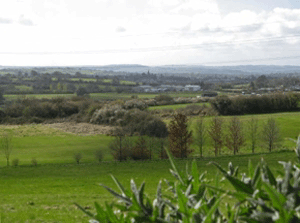
Photo Save Warmley & Siston Green Spaces
Concerned about the ‘corrupt’ nature of the development in her area, Chair of Save Warmley and Siston Green Spaces, Jacquie Stephens said:
“I started this group in July of last year when I heard about the Regional Spatial Strategy wanting to build 8000 houses on the green spaces around Warmley. Never having heard of this group before I leafleted 200 houses and arranged a meeting in the Community Centre, the aim was to find out if anyone else had heard of this and if so what we wanted to do about it.
“This grabbing of the green belt is not about housing it is about greed, about developers building as many houses as possible on virgin land.”
“Over 200 people turned up most of them not knowing what was going on either. We formed a group that day and set out to let our community know what was going on. We found out that we had until October to oppose this plan and this we did. The consultation document was so complicated we had to have open days at the community centre to help people fill in the form but we did it and managed to get the most opposition forms in the South West.
“We want to keep the green belt green because we believe we all need nature and wildlife in order to have quality of life. Once concreted over, this land can never be regained. We lose the wild deer, the birds, the badgers, the bats, the wild flowers, the fauna. We also create more transport more pollution more stress and more urban sprawl. There are brown field lands that can be built to create good housing that ordinary people can afford.
“This grabbing of the green belt is not about housing it is about greed, about developers building as many houses as possible on virgin land. It is ironic that the developers that have bought the land at Barry Road in Oldand are the same people who did the research for the Regional Spatial Strategy the ones who told them how many houses to build and where to build them!!! This land is now up for planning unless we stop it.”
Ashton Vale Heritage Group
www.ashtonvaleheritage.co.uk
A spokesperson for Ashton Vale Heritage Group said:
“Ashton Vale Heritage Group was formed in response to an unprecedented number of planning proposals for Green Belt in and around at Ashton Vale.
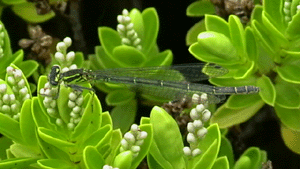
Photo Ashton Vale Heritage Group
“The group had expected an application by Bristol City Football Club, but were taken by surprise in September 2008 when contractors moved into a Site of Nature Conservation Interest and noted wildlife corridor and systematically grubbed out over half a mile of important hedgerow.
“The fields, as you will see in our photos, are a wildlife haven, supported by aquatic plants such as rare sedge and reeds on what is an active natural flood plain. The area is also host to rare water fowl and supports at least six species on the red list. The area has also seen the re-emergence of otters which have become almost extinct around the UK. The area also supports a number of bat colonies.
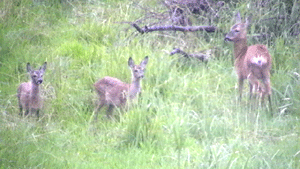
Photo Ashton Vale Heritage Group
“The area is much loved and visited by local people, but also by people with an interest in nature conservation and biodiversity. Our objection to the current applications have been supported by Avon Wildlife Trust and the Bristol Naturalists’ Society. The fields have been the local area’s natural green space and is classed as open space, a unique wildlife area, sitting on the edge of a city. For years we have enjoyed family days, picnics, street events, BBQs, Balloon Fiesta parties and so much more in the fields. Each year having a bonfire party and hosting many other events. It’s a lovely area where you can still see children wandering with fishing rods to catch tiddlers, picking blackberries and slows and making dens. I, like many other people living here, have played in the fields since childhood. To see the fields and wildlife disappear to this mass development is tragic.
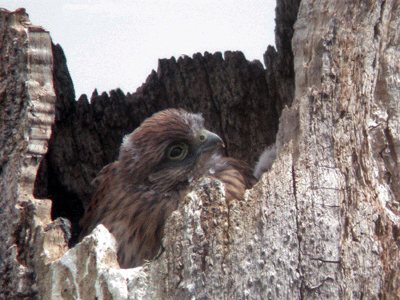
Photo Ashton Vale Heritage Group
“Having natural green space is very important to development and to the growth and sustainability of a community. It is a unique area here, many third and fourth generation families live in a village like atmosphere. Because the approach to Ashton Vale is under a single lane railway arch, it has been protected. People only come here if they have a reason to come into the Vale, there is no through road or short cut so wildlife and the community have flourished. We believe small communities like this should be protected and enhanced. It’s quite old fashioned, in that families stick together, help with childcare and socialise together. It’s an area with very low crime and good community spirit.
“We are calling on people everywhere to join us in stopping any more green belt being eroded. Once gone it is gone forever.”
“But all that is about to change and if these applications are agreed then this small community of just 850 houses will be swamped by 10,000 houses (an area the size of Clevedon), a massive 42,000 seat football stadium, arena and conference centre, fast food restaurants, and heavens knows what else as only some of the plans have been published, and for good measure a bus rapid transit route which will wield its way across the fields from 5am in the morning until 1.00am
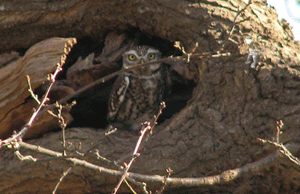
Photo Ashton Vale Heritage Group
“All of these applications are proposed on Green Belt Land. Land which has been protected from urban sprawl has now been identified as a new urban extension. So although we are only a small community we have a huge determination to fight as hard as we can to try and stop not one, two or three but four major developments. I want other children in South Bristol to be able to enjoy what I enjoyed as a child. People will say we are NIMBYs and yes, we admit it, we don’t want a 42,000 seat stadium and 10,000 houses and a bus route in my back yard, but we don’t want it in your back yard either and that is why we are calling on people everywhere to join us in stopping any more green belt being eroded. Once gone it is gone forever.”