
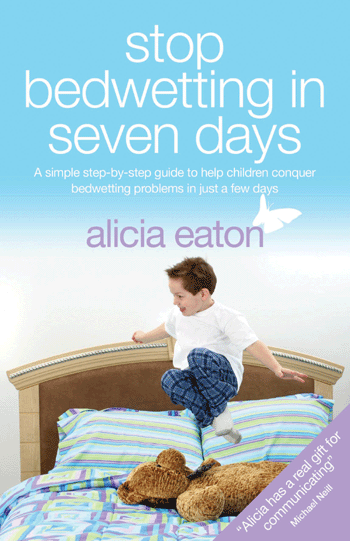
Stop Bedwetting in Seven Days
As children naturally move from nappies into pants, the last stage of staying dry through the night finally clicks into place for most around the age of five.
Once children have reached the age where they start to lose their milk teeth, night dryness should be in place.
But more than 750,000 children in the UK still accidentally wet their beds at night.
The true figure is believed to be much higher. This is because the perceived stigma of nocturnal enuresis, otherwise known as bedwetting, seems to be kept secret within families.
Stop Bedwetting in Seven Days cuts through the stigma and is dedicated to helping these families steer their children through a basic bodily function – not wetting the bed during sleep.
This is something that even seems to eludes three per cent of all 15 year-olds in the UK.
Author Alicia Eaton is a qualified Clinical Hypnotherapist and Advance Practitioner of Neuro-Linguistic Programming (NLP).
Using these techniques, positive thinking, visualisation and all written by a confident author, the book persuasively gets parents to ditch the waterproof pants, alarms and more alarmingly prescription anti-depressants from the doctor.
Make no mistake, this is not a wishy washy waste of time, but a practical step by step guide that is so sensible failure just doesn’t seem possible.
Through some simple child friendly tasks, Alicia helps children to make a subconscious connection between a full bladder and the brain waking up the body to get up and go to the toilet.
We are hoping Alicia brings out a book telling us how to turn the volume down on our inner dial that tells us to raid the biscuit tin.
Mainly suitable for children age six and upwards, if your child is still wetting the bed, don’t go down the route of scary warning alarms or prescription drugs. Ditch the waterproof pants and trust the next seven days with this clever book.
To get you started, check out these fantastic Top Ten Tips from the author – Alicia Eaton
1. If your child is continuing to be wet at night after the age of five, it’s a good idea to have a check-up with your GP to rule out the possibility of any medical causes, such as an infection which can be easily cleared up with antibiotics.
2. For the majority of children, the cause is simply a case of habit, so don’t automatically assume that there’s an emotional reason behind the wet beds. However, if your child has been dry for several months or even years and suddenly starts having wet beds, first consult your GP and then have a think about whether a change at home or stress at school could be a contributory factor.
3. After the age of five, it’s best to remove any nappies or pull-ups worn at night and simply protect the mattress from now on. Your child’s mind is more likely to make that vital
mind/body link if he can actually feel the wetness as it happens.
4. Make night-time changes easier by putting two layers of sheets on the bed and slipping an absorbent pad in between. If your child does wet in the night, you’ll be able to remove the top layer leaving a dry ready-made bed for your child to climb back into.
5. Avoid ‘lifting’ – waking your child at around 11pm and taking them to the loo just before you go to bed yourself is, in fact, ‘training’ them to not only release urine when they’re half asleep, but also to develop a need to go to the toilet in the middle of the night.
6. Avoid using ‘reward systems’ to encourage dry nights. Introducing treats such as money, toys or sweets will only distract your child at just the moment they need to be concentrating on their ‘goal’ – dry beds. There’ll be plenty to reward your child once he becomes successful, such as worry-free sleepovers and school trips.
7. Ensure the route to the bathroom is well lit at night, perhaps even leaving a light on in there. But do avoid night-lights in the bedroom itself – your child will experience a deeper, better quality sleep if the room is dark and this alone may ensure a dry night.
8. Clear away clutter – your child needs to feel confident about getting up out of bed in the middle of the night should he need to use the bathroom. Check that the route is completely clear, without left-over jigsaw puzzles, toys and dirty clothes getting in the way.
9. Make the bathroom child-friendly and allow your child to choose some of the accessories, such as colourful handtowels. This will help them feel that this space belongs as much to them as to the adults in the house.
10. Stay positive – remain encouraging and enthusiastic throughout this period of re-training. Avoid giving any negative feedback – even a raised eyebrow will let your child know that you’re not happy. This will only make it harder for him to succeed as his ‘self-image’ will consist of feelings of failure. Remind your child of all the other things they were successful at learning, such as writing their name, tying shoelaces or hopping on one leg. This is just one more thing that they’ll learn how to do.
Stop Bedwetting in Seven Days
£9.95