
Taking a Proactive Approach to Pregnancy Pain
By Emma Jones
It is widely known that pregnancy comes with a certain amount of pain and discomfort, especially in the back and feet. What may not be so well known is that there are proactive, drug free actions that every woman can take to alleviate, and even eliminate, pain. Here, award-winning physiotherapist and expectant mum Emma James explores some easy steps that every woman can take towards a pain free pregnancy.
We have to put up with a lot of physical changes to our body in pregnancy – something I am now experiencing for the first time myself – and there’s nothing we can do, other than to gracefully accept it. However, it is important to realise that it is only the physical changes we have to manage – not pain. Pain isn’t part and parcel of having a baby. There are steps that we can take – from simple changes to our routine to specialist orthotics (foot support you wear in your shoes) – that can dramatically affect our comfort throughout pregnancy.
Pregnancy puts a huge amount of strain on the body – it has been likened to strapping a bowling ball to your body and walking through soft sand. If you do not pay due care and attention to pain and discomfort during pregnancy, you may end up with longer term problems.
In terms of your body’s biomechanics, the pelvis is the centre of the universe. Everything moves around the pelvis; your spine sits on it, your legs and feet are suspended from it. During pregnancy you have the increasing weight of the baby pushing down on it and changing your posture. Without proper foot support your body will have will also absorb increased forces from the ground – causing pain in feet, knees and hips, encouraging the pregnancy waddle and the infamous pain in the small of the back. This problem is exacerbated by the fact that the body releases the hormone ‘relaxin’ during pregnancy to help loosen the ligaments for childbirth, but this in turn loosens the ligaments in feet too. Keeping feet stable is very important during pregnancy because if you stabilise the feet, you stabilise the pelvis.
It will probably come as no surprise to learn that the first place I look for the cause of pain and discomfort in pregnant women is the feet. In my practice, I use a specialised GaitScan machine that collects over one million pieces of data to give a holistic picture – both static and dynamic – of the effect of pressure and movement on the structure of the feet. I have included two of my own GaitScans here – one at the beginning of my pregnancy and the other at 14 weeks – so you can see how rapidly pregnancy impacts the body, and how much the foot can reveal about the changing biomechanics of a pregnant woman.
So what can be done to alleviate pain and discomfort in a changing body? In my experience there are five easy steps:
Do not ignore pain or discomfort, or simply accept it as part of the process. Pain is your body’s way of telling you that something needs to be addressed. Act. Speak to your midwife, your doctor or a physiotherapist for an assessment and specialist help.
Do gentle exercise. It will not only help you adapt better to pregnancy but help build strength and endurance for labour and beyond. Suitable exercises include walking, swimming, stretching (including yoga and pilates) and low impact aerobics. I have included a good exercise called ‘Superman’ below.
Avoid eating for two. You really don’t need the calories at all in the first six months and in the last three only need an extra 200 calories a day. Excess weight will put extra strain on your legs and feet.
Rest and relax when you can. A pregnant woman needs more sleep. If you are unable to sleep more, then learn to rest when you can. Practice deep breathing to help you relax. Inhale slowly as you count to four while pushing out your abdomen. Relax your neck and shoulders as you slowly exhale while counting to six. Repeat.
Move consciously. Become aware that you need to take extra care of your body. Need to pick something up? Bend at the knees. Don’t twist suddenly. Don’t make sudden movements.
Too often women prioritise the health and wellbeing of the baby over themselves. It’s not an either or situation. You need to be fit, strong and healthy to be a happy, and effective mother. These steps will help.
Emma James is an award winning physiotherapist with practices in Hemel Hempstead and Champneys Medical, a leading residential medical centre based in Champneys Tring. Here she is pioneering the use of GaitScan, a revolutionary diagnostic device for assessing biomechanics, please refer to: www.togorthotics.com for further information.
Superman
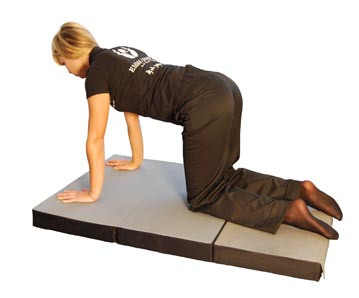
Start on all fours with hands under shoulders and knees under hips
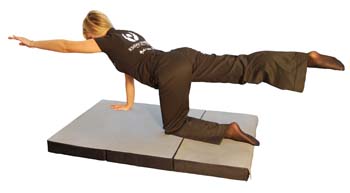
Extend arm forward level with shoulders
Extend opposite leg back level with hips
Keep neck level with shoulder, do not look up or down
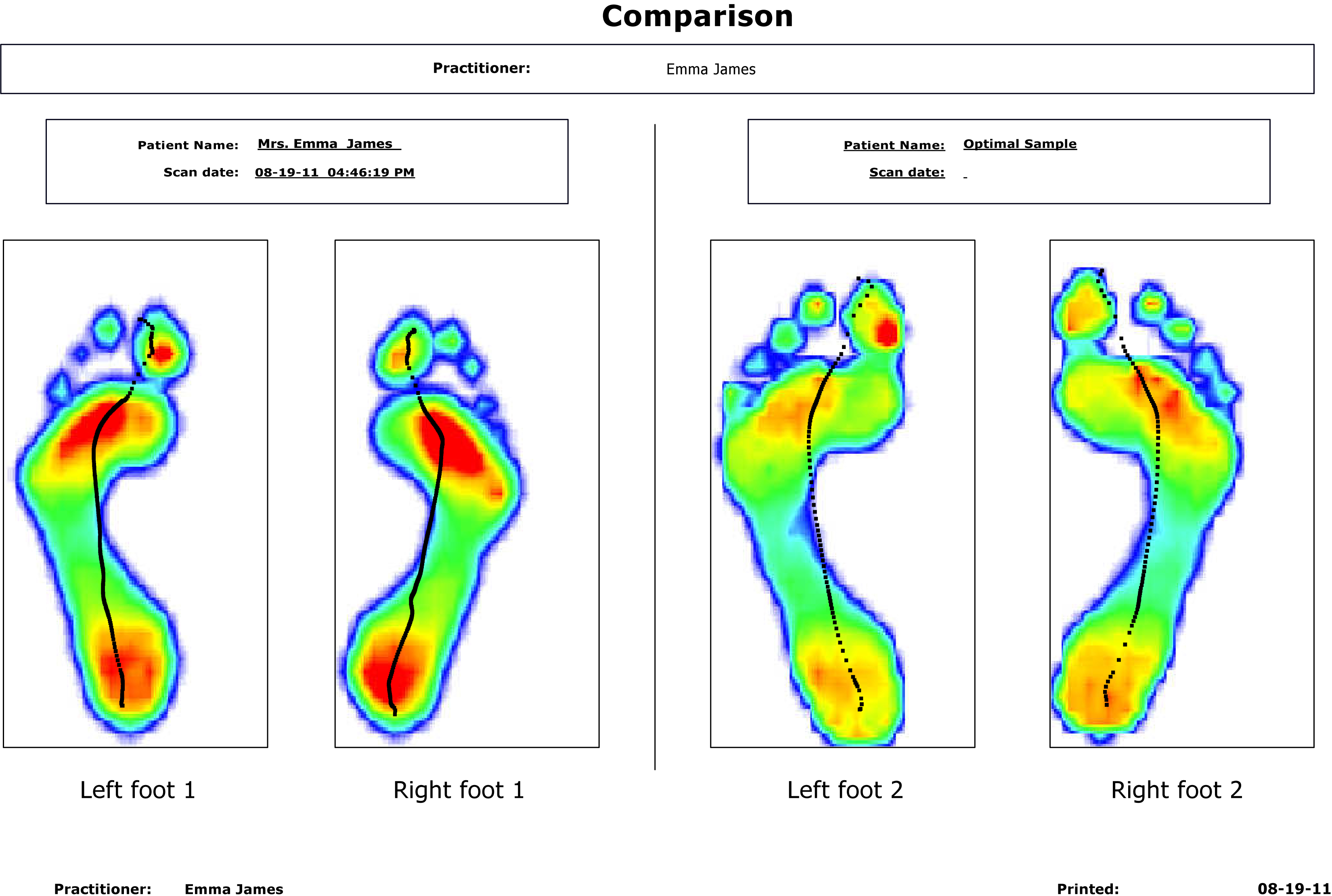 Click to enlarge
The GaitScanon – The left was taken at the start of the pregnancy, then repeated at 14 weeks on the right. This image shows instability in my knee, particularly in the right side, which is indicative of poor hip control. This may be due to the laxities or my excess weight. The pressure line (in black) has moved from the inside to the middle of my toe, which shows that I am now forcing a lot of pressure through the toe as I walk. Again, this may be due to excess weight rolling the foot in (the tibialis posterior tendon is not strong enough to pull my toe up due to the excess pressure). During pregnancy, a slower gait is to be expected and more pronated (flat feet) plantar pressure as pregnancy progresses, particularly in the third trimester. This pronation can be seen in my right foot.